

Marx Big Dial Blast Off Pinball
A nostalgic blast from the past


Exploring the intersection of spaceflight history, pop culture, and space art.
As we roll into the gift giving season, Creating Space presents a game that many 1960s-era space-enthused kids might have flipped to see under their holiday trees. I invite you to have a ball exploring the Marx Big Dial Blast Off Pinball game from 1968!
Are you new to Creating Space? It’s the NERDSletter that explores the intersection of spaceflight history, pop culture, and space art. You can find this and all other posts at creating-space.art.
Game of the Month
There are many ways in which one can make a connection to history in daily life. For instance, no matter your age, there are countless books and online resources available to feed your appetite for historical knowledge. Museums, of course, specialize in preserving knowledge and artifacts from the past in many subject areas. Certain genres of art capture historical times, objects, and events. You may have collections in your own home (or know someone who does) that include toys, games, models, or other collectibles that derive their inspiration from history.
Marx Big Dial Blast Off Pinball
Thus is the case with the Marx Big Dial Blast Off Pinball game. Its theme is set squarely in its time of 1968, and extends into its own past by a decade or so. What was then a showcase of contemporary Cold War missiles, spacecraft and aircraft, now has become an object of historical interest of times gone by.
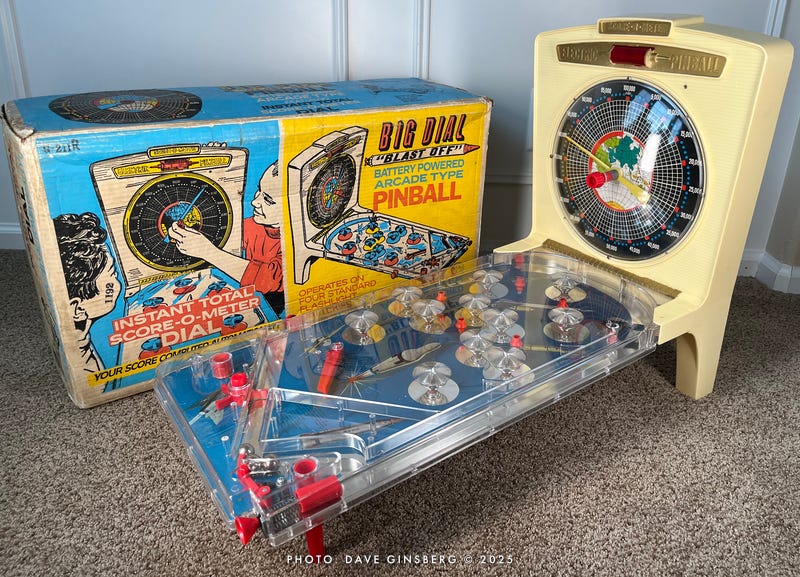
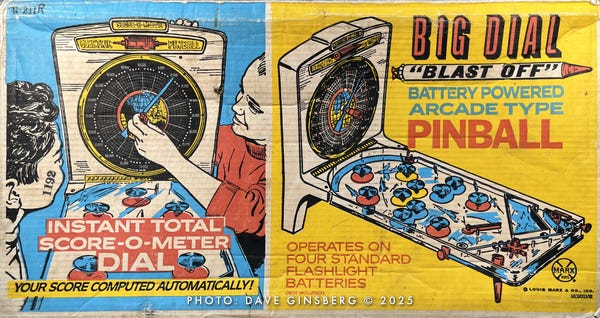
The not-so-subtle mention of the phrase, Blast Off, on the box gives just a hint at the treasure of space vehicle illustrations to be discovered inside.
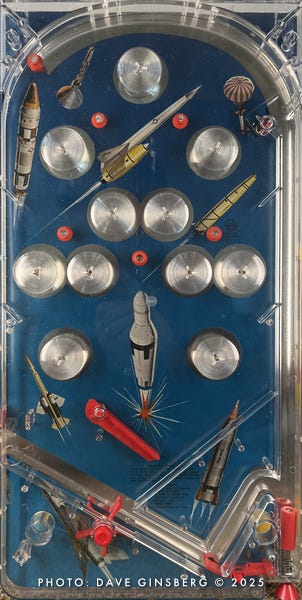
The playing field draws your attention with a blue sky filled with missiles from the Cold War era. We’ll take a closer look at each one in due time.
The score board, or “Score-O-Meter”, is topped with a working red flashing light (batteries not included) and, as the game’s name makes obvious, a big dial to track your score.
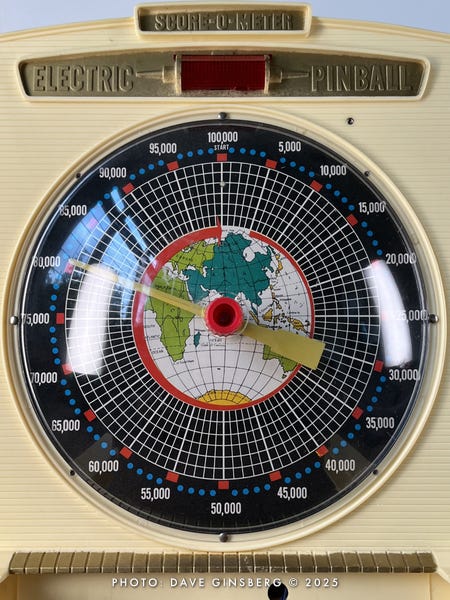
The second-hand-sized needle indicates your ever increasing score as it sweeps clockwise, tracing an orbit around the central globe. Your prime target, identified innocently enough only as “Asia” (but, we know what they really mean) is aligned prominently in your sights. Thank goodness so many of the fathers and mothers of the generation of kids who played this game decided to focus their sights – and missile launches – on the Moon, and not our own fragile planet.

When put together and played, with its overall form, sights, and sounds, the game becomes a close approximation to actual arcade pinball games.
Here’s a short video demonstrating the game in action.
Flipping the Script
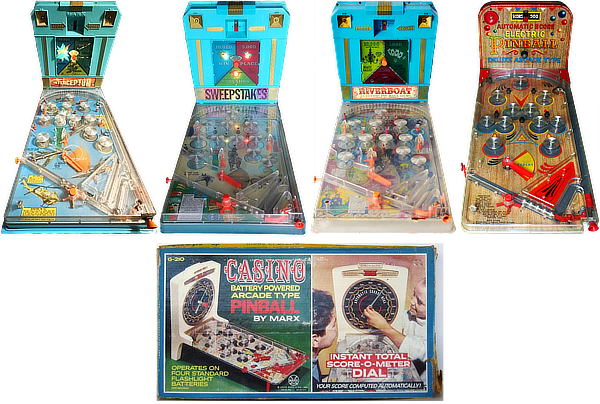
Marx sometimes re-themed their toys to capture a wider variety of interests. On the off chance that you were not a fan of Cold War missiles (not you, of course), Marx had you covered with several theme variations based on similar pinball platforms.
The Interceptor let you imagine piloting a variety of U.S. Air Force fighter jets and a helicopter. If gambling was your thing, there was a casino-themed version for you to try your luck with. If you would rather bet on the horses, the Sweepstakes gave you an opportunity to win, place, or show. If betting while floating down the waterways of America was more your thing, the Riverboat promised to take you there. And, there was a version simply called Electric Pinball that had an authentic-looking vintage simulated wooden playing field.
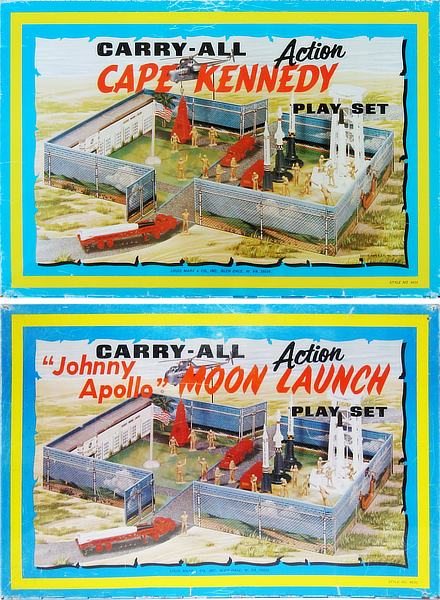
The practice of re-theming toys was not limited to pinball games. Marx used this tactic on their Carry-All line of miniature playsets. As with the pinball games, the common architecture of the Carry-Alls was able to play multiple roles with minor alterations to the design and the included contents.

Here’s a case where the branding was updated to put more emphasis on NASA’s 1960s lunar landing goal, and to tie in more closely with their Johhny Apollo action figure line of toys.
Plunging into the Details
Let’s take a tour around the playing field of the Big Dial Blast Off pinball game to see what one of the chrome balls might see as it is shot into this space.
The ball is set into motion by the spring-loaded plunger. Launching up the shooter lane, it enters the first turn, following the broad arc at the top of the playing field. It speeds by the first of the spacecraft illustrations – a Mercury capsule joined to its launch escape tower. If this looks odd to you, it may be because this configuration (without a booster beneath it) was only ever used once during a so-called Beach Abort test of the Launch Escape System in July 1959.
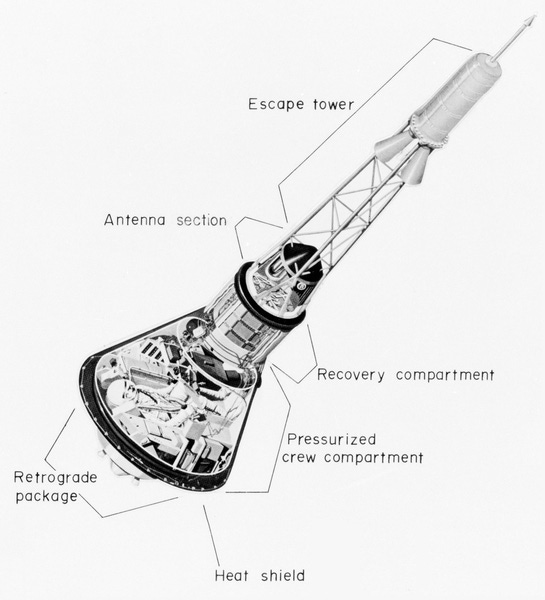
In the event of an actual mission emergency, the escape tower would fire its solid rocket motor and pull the capsule away from the ill-fated launch vehicle. The tower would then be jettisoned just after the escape rockets cut off and a recovery parachute would deploy, bringing the capsule and its contents to a safe landing.
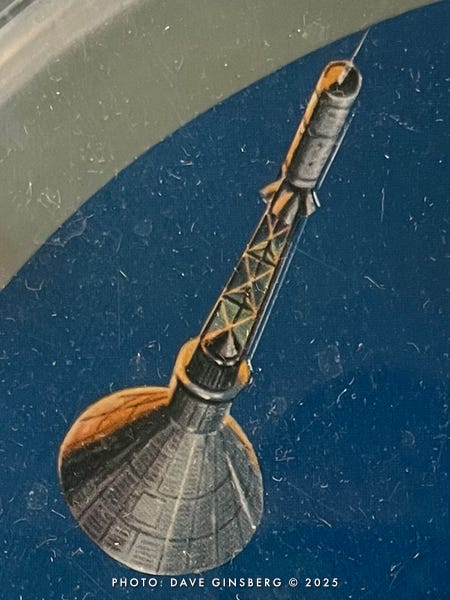
Project Mercury was NASA’s first manned spaceflight test program which ran from 1958 through 1963. In total, six men were launched in Mercury capsules – the first two on top of modified Redstone missiles sent on suborbital trajectories, and the following four send into Earth orbit on Atlas missiles. Prior to the human-crewed flights, the Mercury-Redstone system was tested with a brave (though not likely fully informed) chimpanzee named Ham.
The following cutaway diagram shows the layout of the Mercury capsule and its launch escape tower.
Returning to our pinball’s mission, after speeding by the Mercury capsule, the ball strikes a small red passive bumper and catches a quick glimpse of a Titan II intercontinental ballistic missile (ICBM) soaring skyward.
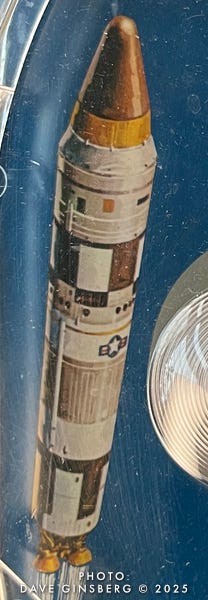
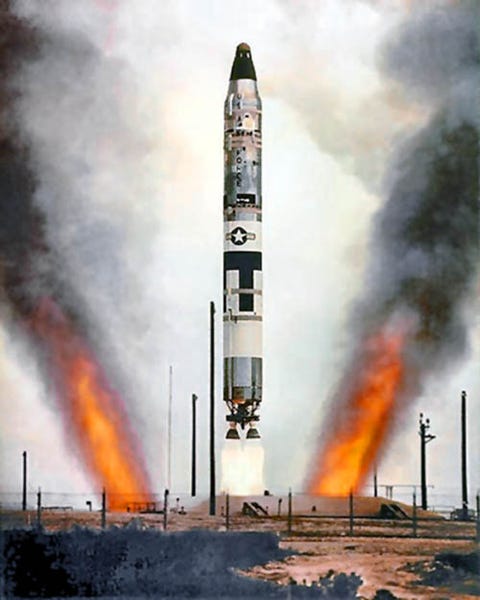
The Titan II was a 1959 upgrade to the U.S. Air Force’s two-stage Titan I ICBM. It was the last liquid-fueled intercontinental ballistic missile built by the United States. It was in service between 1963 and 1987.1 A derivative of this missile was used for NASA’s Gemini program between 1964 and 1966. Ten crewed missions were flown, each carrying two astronauts. The program tested and proved a number of technologies, procedures, and capabilities that were essential to the success of the follow-on Apollo lunar missions.
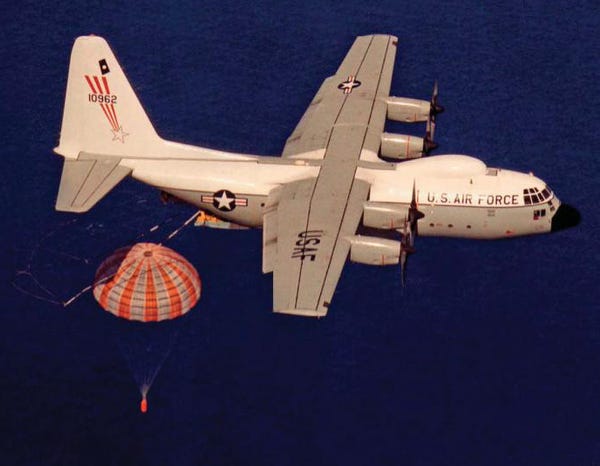
Now, back on the pinball playing field, immediately after impacting the bumper, our Steely-eyed Missile ball reverses course and – given enough speed – arcs back across the top of the board and is stopped from falling back down the launching chute by a thin strip of spring metal. It is here that a recovery parachute is seen with an unidentified rocket suspended beneath it. The identity of this object is a mystery to me, but given the Cold War theme of the game as context, one might guess it could represent an early concept for a film container from a space-borne reconnaissance satellite. If that is the case, it may be likely the illustrator employed some artistic license – perhaps to fill in gaps in knowledge due to a lack of access to possibly sensitive reference material.
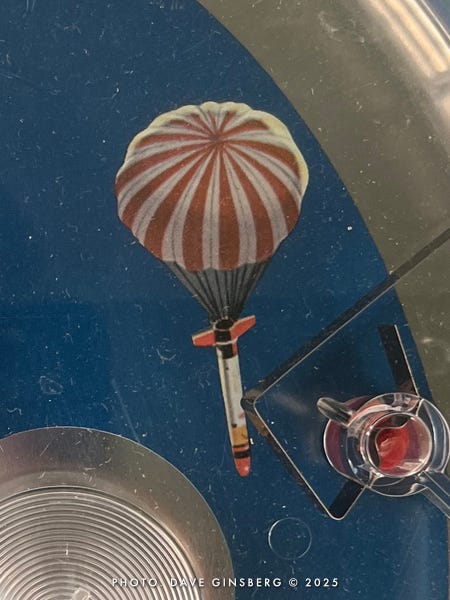
Going with the spy satellite theory, here is an example of how film canisters were recovered in mid-air after deployment from their orbiting host satellites. This particular photograph shows a practice run of a JC-130B catching a simulated film-return capsule.
Our intrepid chrome sphere is sent back into the playing field, and after bouncing off an active bumper or two – marking the start of the scoring with a reassuring ding-ding – the ball encounters a Hound Dog missile.
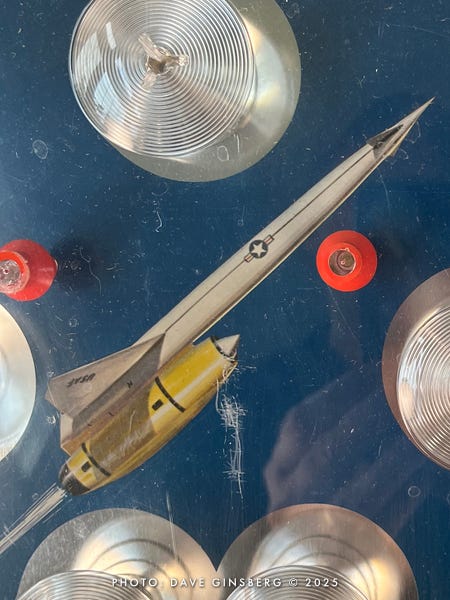
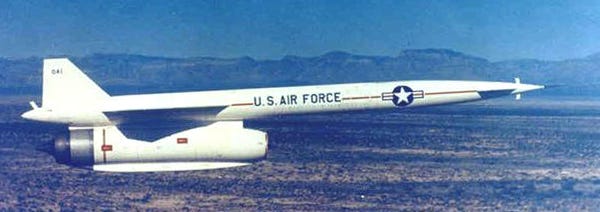
North American Aviation’s AGM-28 Hound Dog was a supersonic, turbojet-propelled, nuclear armed, air-launched cruise missile developed in 1959.2 The Hound Dog was Strategic Air Command’s (SAC) first air-launched missile. One was carried under each wing of the B-52G Stratofortress. Their mission was to attack and destroy enemy air defenses, such as fighter aircraft bases, communication centers, and anti-aircraft missile batteries thus clearing the way for the bomber to more successfully strike its target.3
If the proverbial winds are in the right direction, our pinball may next meet with a Thor intermediate range ballistic missile (IRBM) seemingly headed off in the same direction as the target of the Hound Dog.
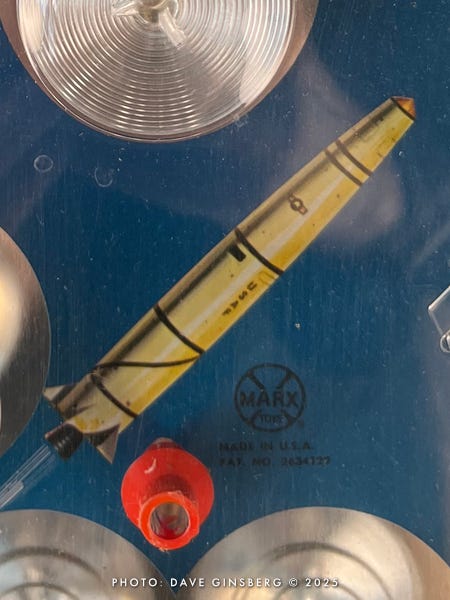
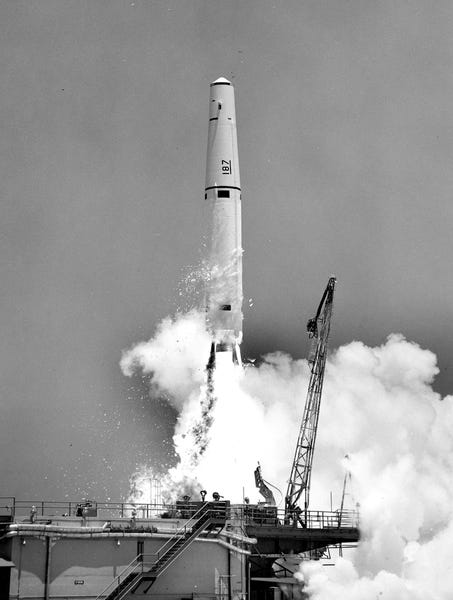
The Air Force initiated development of the Thor in 1954 as a tactical missile that could deliver a nuclear warhead up to 2,300 miles (3,700 km) from a launch site. Douglas Aircraft Corp. was awarded the prime contract for the airframe and integration of components. The first test flight was Jan. 25, 1957.4 It was deployed in the United Kingdom between 1959 and September 1963 as an intermediate-range ballistic missile with thermonuclear warheads.5
Passing through a gauntlet of bumpers, the ball now enters the center of the playing field where it is met by a newly launched Polaris missile. This is your chance to boost the ball back into the upper altitudes using the big red flipper – if you can get it past the three pairs of bumpers forming an overhead defense shield.
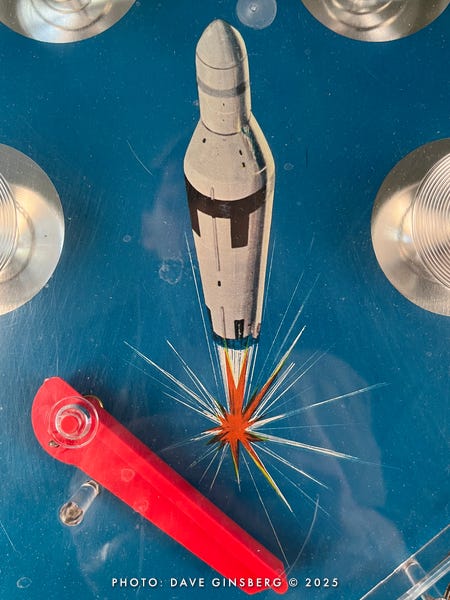
Polaris was a two-stage ballistic missile powered by solid-fuel rocket motors and controlled by a self-contained inertial guidance system. It was designed to be launched from a submerged submarine. On July 20, 1960, Polaris became the first ballistic missile to be launched from a submarine under water.6
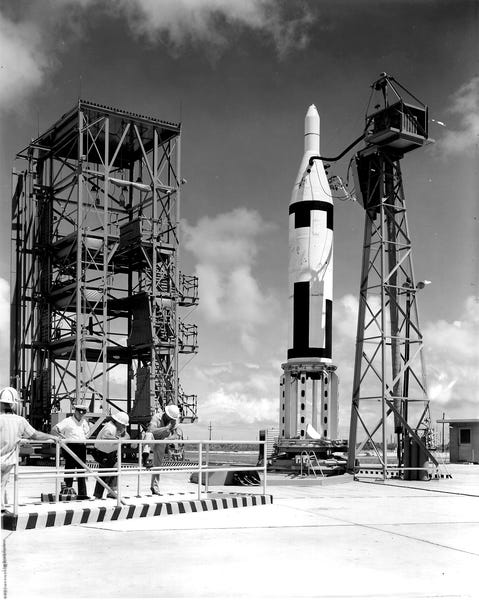
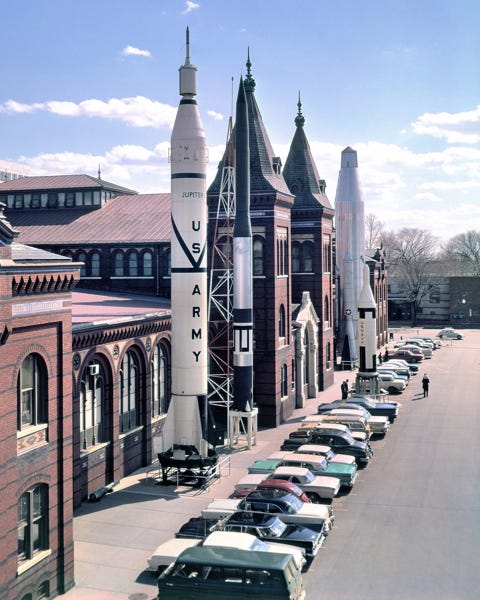
I remember the first time I saw a Polaris missile in person. It was during one of my early childhood visits to the Smithsonian. Taking its place prominently in front of a row of three other rockets and missiles outside the Arts and Industries Building was one of the early models of the Polaris A-1. The other rockets were, from left to right, Jupiter-C with replica Explorer 1 satellite, Vanguard, and Atlas B. An Atlas comes up next in our pinball tour ...
If you are lucky with the big red flipper, you may send the ball past the nuclear warhead of an Atlas intercontinental ballistic missile. If you get a good bounce, the ball may stay in play.
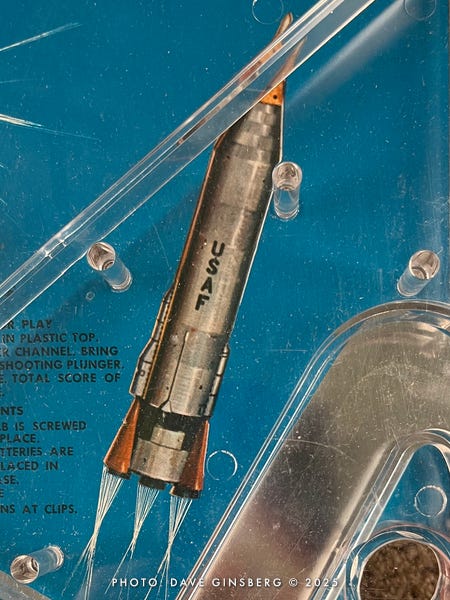
The SM-65 Atlas was the first operational intercontinental ballistic missile developed by the United States and the first member of the Atlas rocket family. It was built for the U.S. Air Force by the Convair Division of General Dynamics.7 When not used as a nuclear threat, Atlas-derived launch vehicles were later used to loft four of NASA’s manned Mercury Program missions in the early 1960s, and employed in the Gemini Program for sending Agena docking targets into Earth orbit. Several unmanned exploratory lunar and interplanetary probes were launched with Atlas-Agena configurations.
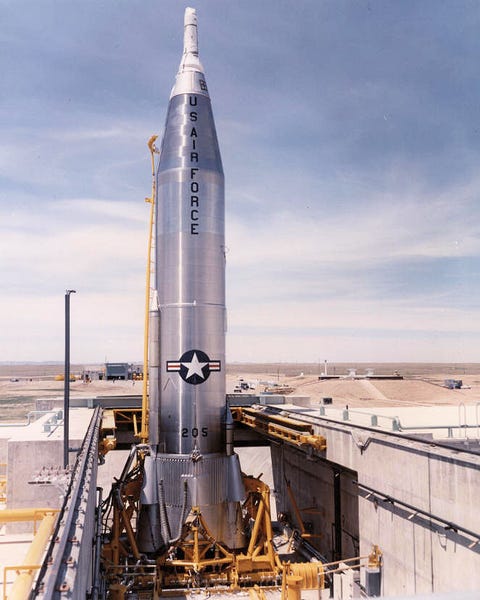
If your flipper skills fail you, the ball may find itself in the unfortunate position of encountering a Bomarc missile. Once there, the chances of recovery virtually disappear as there is nowhere left to go but downward.
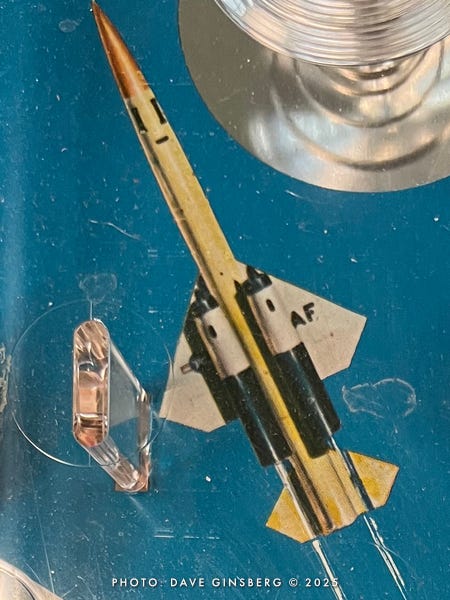
The Boeing Bomarc (named by combining Boeing with the Michigan Aeronautical Research Center, which contributed to the project) was a supersonic ramjet powered long-range surface-to-air missile (SAM) used during the Cold War for the air defense of North America.8
Fun Fact: I used to work in a building named after a planned Bomarc site in the Pacific Northwest.
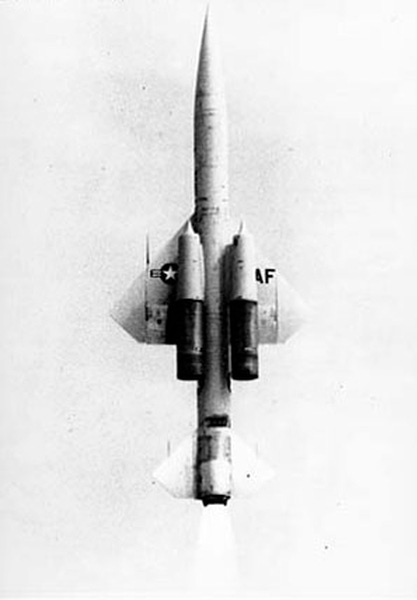
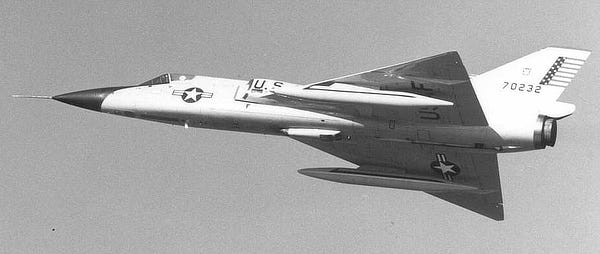
As the silver ball hits bottom, it risks being intercepted by an F-106 Delta Dart.

The F-106 Delta Dart was a supersonic, all-weather delta wing interceptor aircraft of the United States Air Force from the 1960s through 1988. It was manufactured by the Convair Division of General Dynamics. Its mission was to shoot down other aircraft – Soviet bombers in particular. The F-106 was the last dedicated interceptor in the U.S. Air Force.9
I clearly recall seeing this jet, with its distinctive delta-wing planform, soaring over Dulles Airport at the first air show I remember going to as a young boy.
Narrowly avoiding interception by the Delta Dart after its perilous mission, our fearless pinball returns to the hopper, with the help of a manually-operated spinning paddle wheel, to play another round.
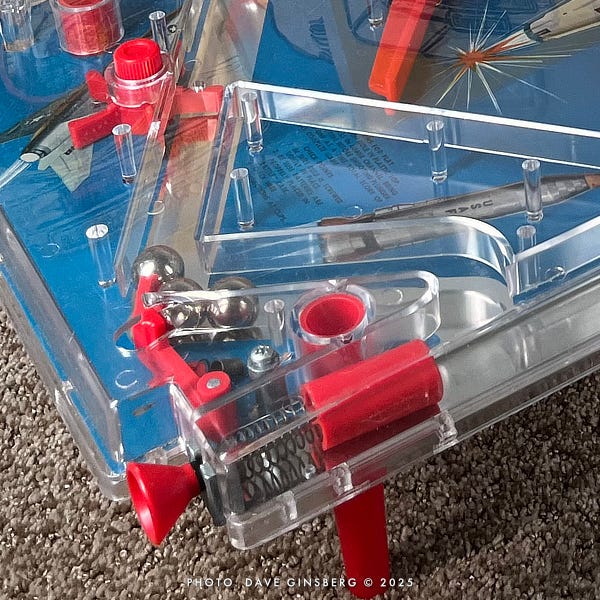

Merch of the Month
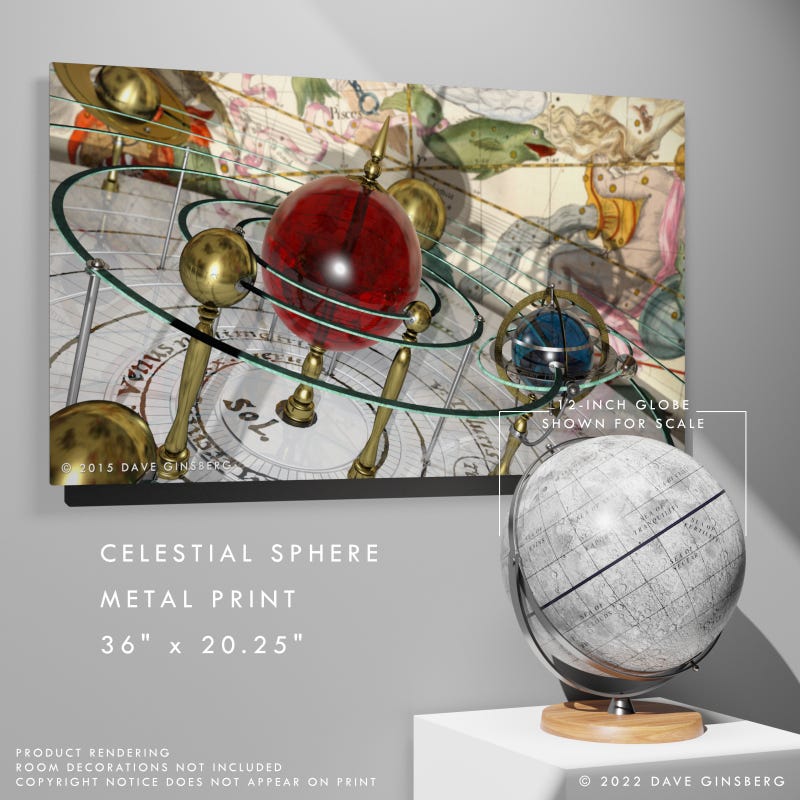
Celestial Sphere Metal Print
Deck your walls with shiny balls!
SOCIAL IMPACT
Your purchase from Pixel Planet Pictures helps support and promote space-related STEAM organizations and initiatives that enable and inspire students and youth to learn, develop, and pursue passions in science, technology, engineering, arts, and math.


I'm Dave Ginsberg, the artist behind Pixel Planet Pictures and writer of Creating Space.
I am an artist and a creative engineer with a love for teaching and passions for spaceflight, astronomy, and science. My space-inspired art portfolio can be found at pixel-planet-pictures.com.

Do you know fellow Space Geeks who might enjoy Creating Space? Invite them into this space, too!
Did you miss a post? Catch up here.

If you enjoyed this article please hit the ‘Like’ button and feel free to comment.

All images and text copyright © Dave Ginsberg, unless otherwise noted. All rights reserved.
Missiles of the World, Missile Threat, April 23, 2024 (https://missilethreat.csis.org/missile/titan-ii/)
AGM-28 Hound Dog, https://en.wikipedia.org/w/index.php?title=AGM-28_Hound_Dog&oldid=1319118824 (last visited Dec. 15, 2025).
AGM-28 Hound Dog Missile, Strategic Air Command.com (http://www.strategic-air-command.com/missiles/Aircraft-Launched_Missiles/agm-28_hound_dog_missile.htm)
This Week in History: AF delivers first Thor IRBM, Kirtland Air Force Base (https://www.kirtland.af.mil/News/Article-Display/Article/389322/this-week-in-history-af-delivers-first-thor-irbm/)
PGM-17 Thor, https://en.wikipedia.org/w/index.php?title=PGM-17_Thor&oldid=1320317918 (last visited Dec. 15, 2025)
Polaris SLBMS/SSBNS, warhistory.org, Mitch Williamson, August 06, 2015 (https://warhistory.org/@msw/article/polaris-slbmsssbns)
SM-65 Atlas, https://en.wikipedia.org/w/index.php?title=SM-65_Atlas&oldid=1325537082 (last visited Dec. 16, 2025).
CIM-10 Bomarc, https://en.wikipedia.org/w/index.php?title=CIM-10_Bomarc&oldid=1313313487 (last visited Dec. 16, 2025).
History of the F-106 Delta Dart, F-106 Delta Dart Association (https://www.f-106deltadart.com/history.htm)