

You Will Go to the Moon
A promise made to countless kids a decade before the first of us actually went


Exploring the intersection of spaceflight history, pop culture, and space art.
As I write this article, Artemis II has just sent its four-astronaut crew around the Moon and brought them back safely to Earth. What better time is there to take a look back to an era when people were still dreaming about such an adventure? It is 1959, and you will go to the Moon!
Are you new to Creating Space? It’s the NERDSletter that explores the intersection of spaceflight history, pop culture, and space art. You can find this and all other posts at creating-space.art.
Book of the Month
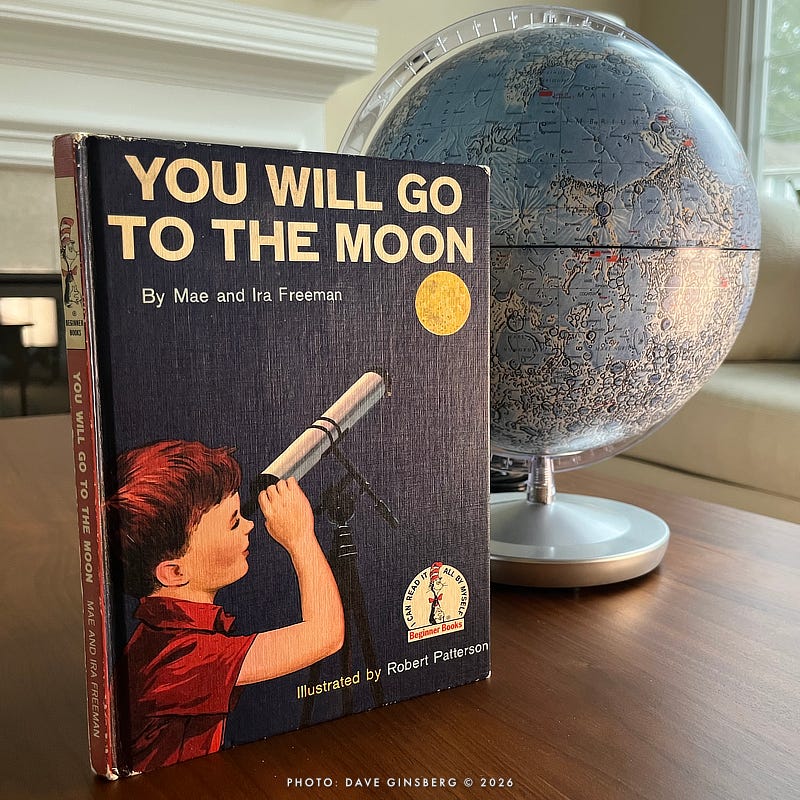
You Will Go to the Moon
Earlier this month, Artemis II sent four astronauts around the Moon for the first time since 1972. I wonder if any of the crew members were promised their adventurous trip by this wonderfully imaginative and foreshadowing book written almost seventy years ago.
You Will Go to the Moon, by Mae and Ira Freeman, illustrated by Robert Patterson, Hallmark Beginner Books, New York, 1959.
The Moon is up there, far away.
The first line of this 1959 children’s space book reminds me simultaneously of a line in Douglas Adams’ book, The Hitchhikers Guide to the Galaxy (“Space is big. You just won't believe how vastly, hugely, mind-bogglingly big it is …”}, and a line from comedian Bill Dana’s (a.k.a. José Jiménez) standup comedy bit called The Astronaut (“And then you`re really up there!”)
You Will Go to the Moon was quite a bold promise presented to kids in 1959. Within its sixty-three pages – a seemingly long read for its intended beginner audience – authors Mae and Ira Freeman outlined an imagined journey to the Moon, collaborating with illustrator Robert Patterson. A nameless preteen boy stands in for the reader as he is treated to a tour of a Moon rocket by the technicians who are preparing it for flight and the astronauts who will make the trip.
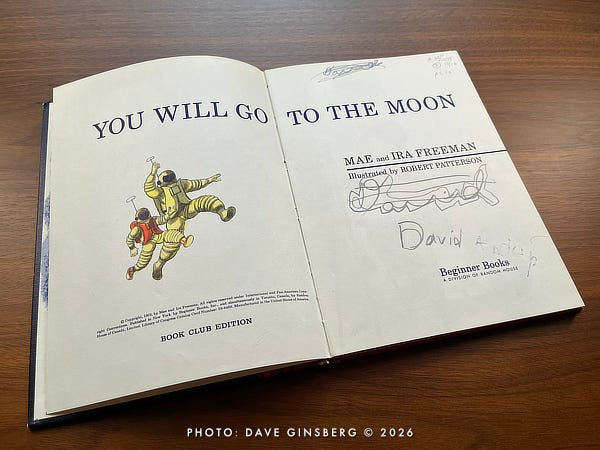
I have a perhaps imperfect recollection of having this book when I was a child. This particular copy belonged to another “David”, though, as evidenced by the multiple penciled signatures on the title page.
The first two-page illustration spread in the book shows a young boy ... let’s call him “Little Davey” ... peering through a telescope at the full Moon. He sits upon a stool surrounded by a train set, a model airplane, and a world globe. His parents watch from the living room, pleased to see their son’s interest in astronomy being nurtured by their investment.
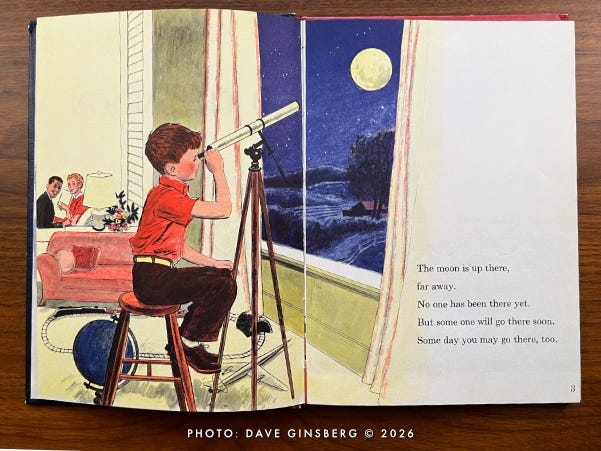
In addition to telling the reader of the moon’s location (“up there, far away”), it states that no one has yet been there, but someday some one will go ... including you!
Keeping in mind the book’s publishing date of 1959, it would turn out to be nearly a decade before someone did, indeed, go. Assuming Little Davey is about 10 years old in this illustration, he would be nineteen when Apollo 8 orbited the first crew around the Moon in 1968. By the time NASA’s Apollo lunar missions completed four years later in 1972, Little Davey would likely still have been too young to have earned the necessary qualifications for the astronaut corps. According to NASA’s website, there are no age restrictions for the astronaut program, but it seems that the most successful candidates are equipped with higher degrees as well as applicable life experiences.
Now, with Artemis II back from sending its crew around the Moon fifty-four years after Apollo 17 returned to Earth, Davey is no longer little. He would be seventy-seven by now. However, this may not necessarily disqualify him from flying a space mission. In fact, it was at that very age that John Glenn made his second spaceflight, aboard Space Shuttle Discovery on STS-95 in 1998. And since then, several people older than that have ventured, albeit briefly, above the Karman Line aboard Blue Origin’s New Shepard. So don’t count out Not-So-Little Davey, just yet.
Getting There
The next thing you know, Little Davey and his parents have left the comfort of their living room and are strutting out to a launch pad where a giant three-stage winged Moon rocket is being readied for its lunar mission. Davey carries a small duffel bag, as if he expects an overnight stay. Mom brought a book, as if she knows this might take a while.
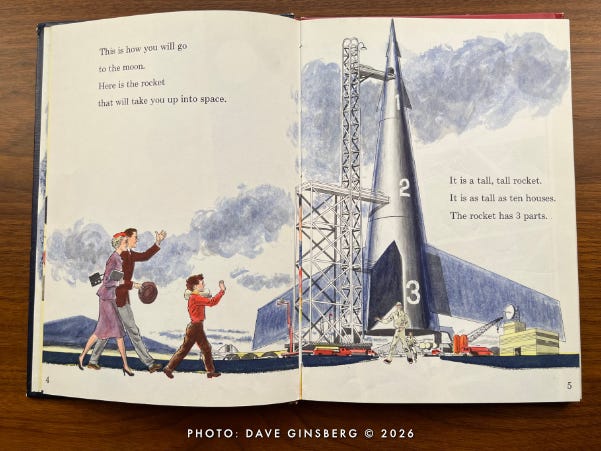
The book’s illustration was clearly inspired by a Wernher von Braun-designed Moonship described in the 1952 book, Across the Space Frontier, written by several spaceflight experts including von Braun, Heinz Haber, and Willy Ley. Also envisioned to be three stages, the rocket’s height was described as being 265-feet (80.8 m) and its weight 7,000 tons (6,350 metric tons). Rolf Klep’s detailed cutaway illustration provides a peek into the inner workings of the mammoth machine.
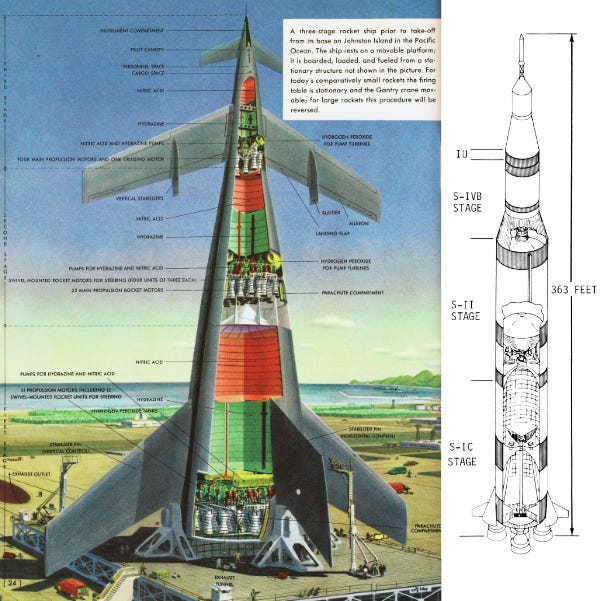
The rocket in You Will Go to the Moon is described as being “as tall as ten houses.” If you assume a typical 1950s single-family two-story house was roughly 25 to 30-feet (7.6 to 9.1 m) tall, the rocket might reach between 250 to 300-feet (76 to 91 m) high. This lines up very well with the von Braun rocket. Ultimately, the Saturn V, NASA’s Apollo Moon rocket, stretched 363-feet (110.6 m) in total, and also had three-stages.
We Are Going
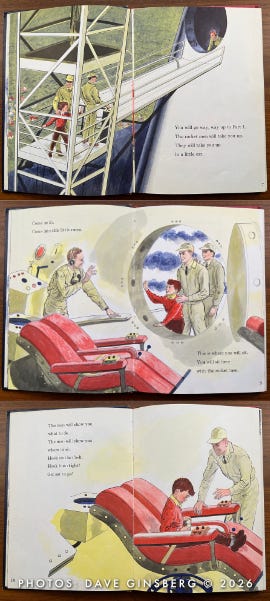
Things start to get real on this field trip as Little Davey is escorted up the launch tower and is invited to climb into the spacecraft. Habit would lead me to call it the capsule, but that might be an inadequate description given its roomy interior.
In no time, Davey is strapping himself into one of the big red couches. The cabin interior is spacious and comfortable. Thick padded cushions cover the seats, ready to cradle you against the high G-forces of the launch. TV remotes built into each arm rest are convenient features of these chairs.
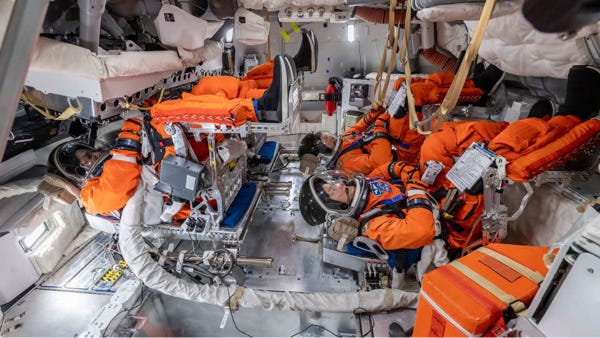
Compare that plush interior with the industrial utility of the Orion capsule. No soft cushions or smooth, streamlined curves to be found in there. Instead, it resembles a three-dimensional obstacle course consisting of jagged angles, elbow-bruising sharp corners, and head-knocking hard surfaces. One might be easily convinced that it was assembled from Erector Set parts. Helmets are advised, and I hope those crew survival suits are well-padded.
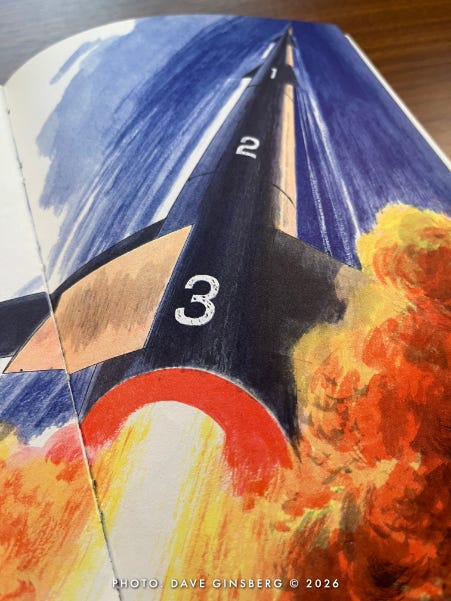
Now, without so much as a countdown or a “Go for launch!”, the rocket has lifted off as quickly as you can turn the page... with Little Davey in it! Could this really be happening, or is it just imagined?
Rockets All the Way Down
You may have noticed the numbered stages in the previous image. Does something look off to you? Maybe it is because we have become accustomed to numbering stages from the bottom-up, calling the lowest section of multi-stage rockets the ‘first’ stage. The Apollo Saturn V, for instance, was numbered in this way with the lowest stage – the one to be ignited first – being the first stage. Each additional stage increased in number the higher up on the stack they were. The upper-most stage, in this case, being the third stage. (I am setting aside the naming of the stages, vs. the numbering, since things can get somewhat complicated. If you know, you know.)
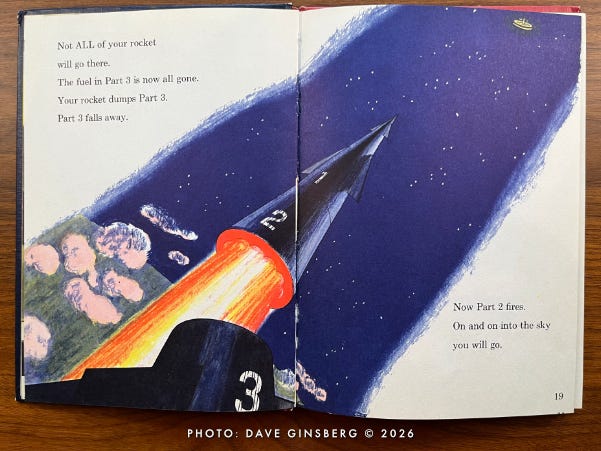
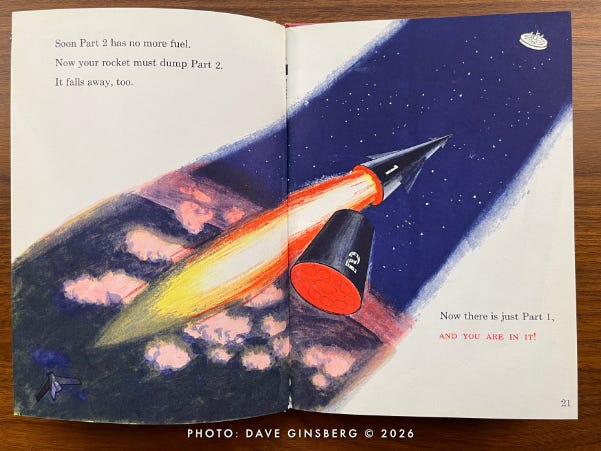
Stage number ‘3’ has done its job. Now, stage ‘2’ has expended its fuel, leaving the final stage to proceed toward its destination.
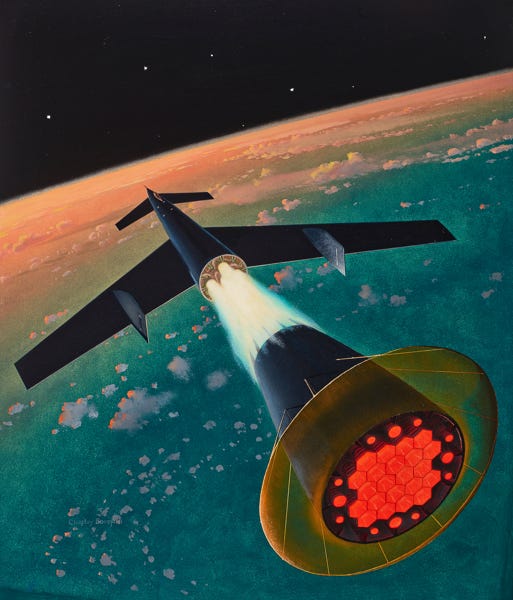
The book’s staging illustrations seem to be strongly influenced by a Chesley Bonestell painting of the von Braun design mentioned earlier. This was published in Collier’s magazine as well as the book, Across the Space Frontier, both in 1952.
The oldest known multi-stage rocket goes back to 14th century China with the Huo Long Chu Shui, or 'Fire Dragon Out of the Water'.1 It consisted of a hollow bamboo tube with a carved wooden dragon head and tail about 5 ft (1.5 m) long. The front and rear contained four rockets packed with gunpowder that propelled the dragon forwards. Just before the four rockets burned out, fuses would ignite arrow rockets hidden inside the belly of the dragon, which would then shoot out of its mouth propelled by the gunpowder.2

A 16th century German fireworks maker, Johann Schmidlap, is credited for inventing the first “step rocket,” a multi-staged vehicle for lifting fireworks to higher altitudes. A large rocket was ignited and carried one or more smaller rockets. When the large rocket burned out, the smaller rockets ignited sequentially, continuing to higher altitudes before showering the sky with glowing cinders. Schmidlap’s concept, known today as staging, is basic to all modern rocketry.3

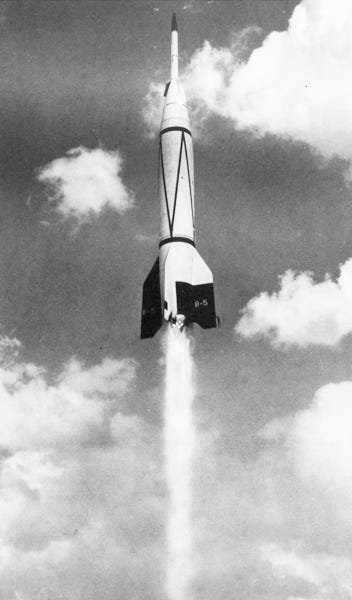
The first modern liquid-fueled multi-stage rocket consisted of a WAC Corporal sounding rocket mounted atop a captured German V-2. Several of these experimental stacked rockets were tested by the U.S. Army at the White Sands Proving Ground in New Mexico under a project named Bumper. The fifth of these succeeded in lofting a Corporal to an altitude of 244 miles – twice the previous V-2 altitude record of 110 miles – becoming the first object to enter extra-terrestrial space on February 24, 1949.4
Station Break
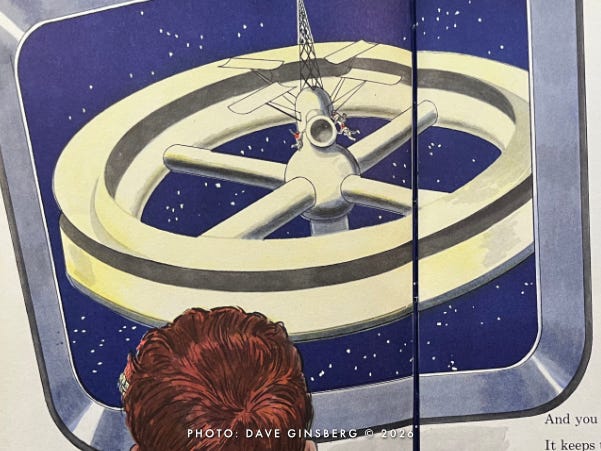
Returning to Little Davey’s adventure, after all of the expended rocket stages are discarded, he notices that there will be a detour on the way to the Moon. A giant wheel-shaped space station looms large in his TV viewscreen. He notices it slowly spinning.
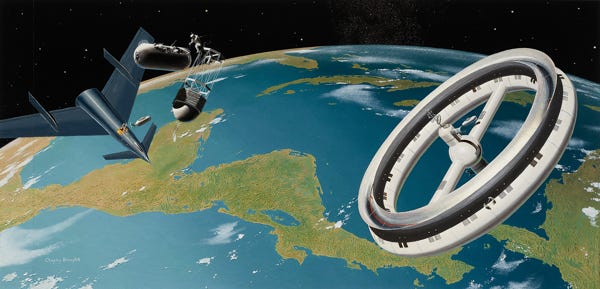
This space station is another design from Wernher von Braun. Here, in another painting by Chesley Bonestell published in 1952 in both Collier’s magazine and Across the Space Frontier, we see the station along with the winged space plane. Astronauts are working adjacent to the space plane, assembling an astronomical observatory, foretelling the Hubble Space Telescope which was sent into orbit in 1990.
Look closer, and you may see another pair of astronauts clinging to the side of the 250 foot (76 m) diameter wheeled-space station. As described in Across the Space Frontier, the station produces “synthetic gravity” caused by centrifugal force as it rotates three times per minute.
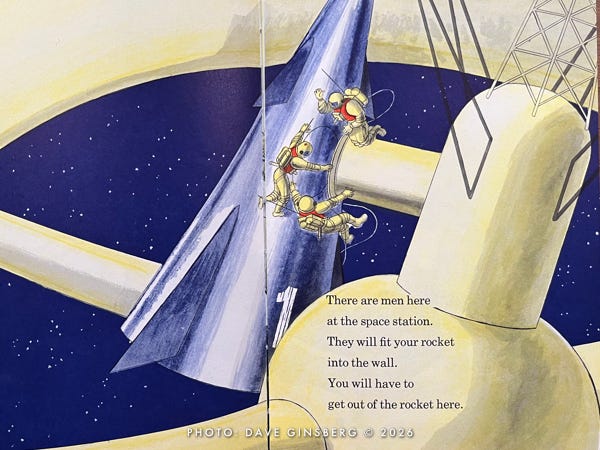
So, how can Davey’s spaceship park at the station if it is rotating? Again, from the description in Across the Space Frontier, the turrets located on the axis of the space station “can be rotated to nullify the rotation of the station and make it appear stationary.” But, that is only part of the solution. Just like at the gas stations of the 1950s, attendants will be there to greet you and, as it says in the book, “fit your rocket into the wall.”
Life Imitates Art
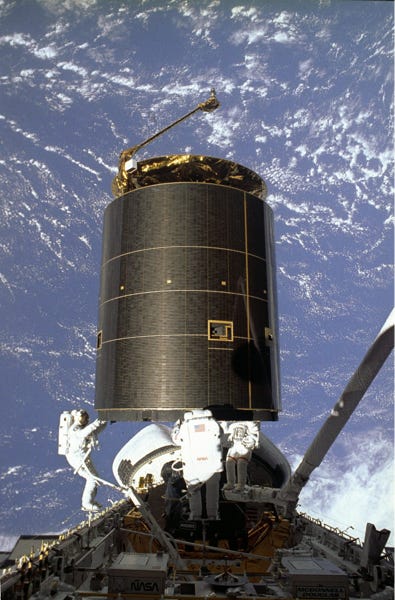
Manually capturing a spacecraft is not as far-fetched as it may seem. A scene strikingly similar to this one actually occurred during the Space Shuttle era. In May 1992, the crew of STS-49 undertook a rescue mission with the goal of capturing an errant communications satellite which had ended up in the wrong orbit. Their first attempts failed when a lone astronaut, equipped with a capture device, succeeded only in nudging the satellite away from him each time he tried latch onto the base of the satellite.
After analyzing the problem, the crew brainstormed a daring alternative solution. Three astronauts would exit the spacecraft together – a first in space history – and attempt to grab the satellite by hand, each while anchored in the Shuttle’s payload bay. The plan worked, and the mission was a resounding success.5
There are other less dramatic examples of life in space looking a lot like early speculative space art. This illustration from the book shows astronauts on the space station enjoying a movie in their leisure time.
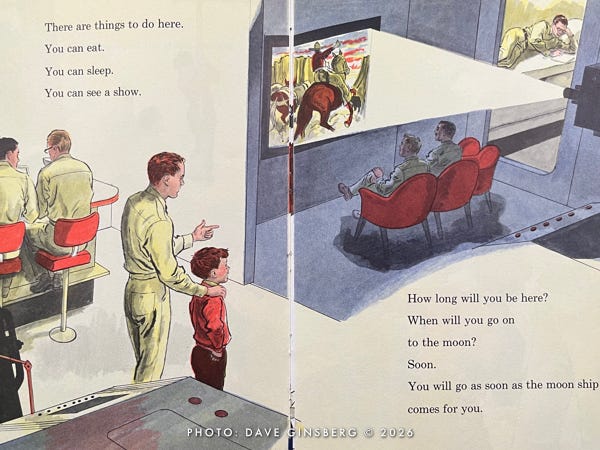
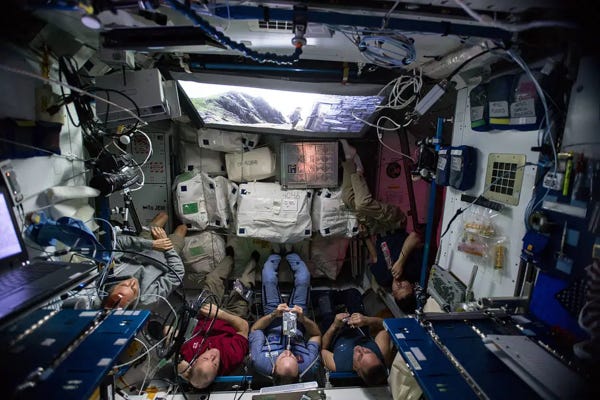
Astronauts on the International Space Station (ISS) have done the very same thing during their times of relaxation. Apparently, there is quite an extensive catalog of movies and television shows onboard the ISS. The Internet Movie Database (IMDb) has a list (last updated in 2022) containing 620 titles! There is a wide selection of genres. Some notable space-themed choices include 2001: A Space Odyssey (1968), 2010: The Year We Make Contact (1984), four Alien movies (1979-1986), Apollo 13 (1995), Armageddon (1998) – and that’s just the beginning of the list!6
Here we see the crew of ISS Expedition 54 enjoying Star Wars: Episode VIII - The Last Jedi (2017).
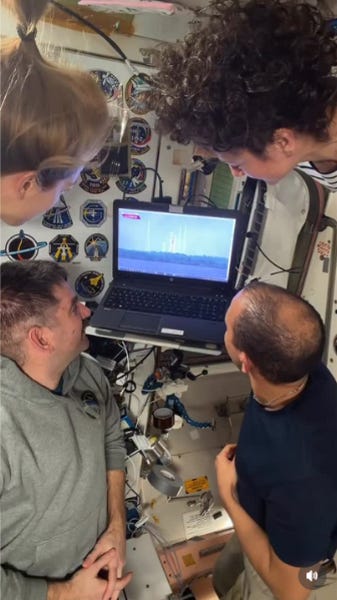
Prerecorded entertainment is not the only type of viewing experience available to current-day astronauts in space. The crewmembers of ISS Expedition 74 watched the live stream of the Artemis II launch on one of the onboard laptop computers on April 1, 2026.
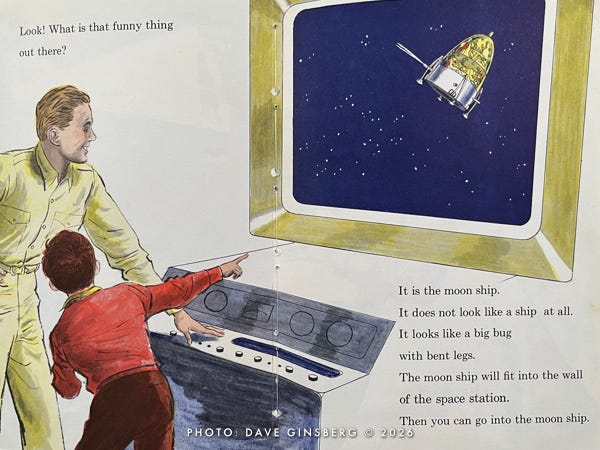
In what seems truly prescient, this illustration showing Davey using a television viewscreen to spot another spacecraft bears a striking resemblance to the scene on the ISS.
And, while we are talking about Artemis II, the mission will go down in history for a number of firsts. Notable among them was, to my knowledge, the first spacecraft-to-spacecraft videoconference. The crew of Integrity (the name assigned to their Orion spacecraft) held a live video call with the Expedition 74 astronauts on the Earth-orbiting ISS. The distance between the two spacecraft was somewhere in the neighborhood of 201,725 nautical miles (373,595 km), depending on where the space station was in its orbit!
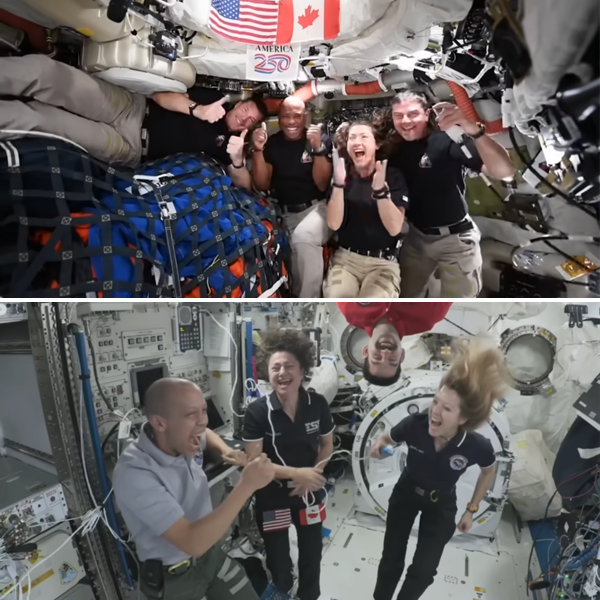
Enjoy the excitement and joyous enthusiasm shown by everyone involved as you watch the video.
“Sooner or later you’ve got to go to the Moon”
In 1968, describing the rationale for the decision to send Apollo 8 to the Moon on the first crewed flight of the Saturn V, Flight Director Glynn Lunney has been quoted as saying, “If you’re going to go to the Moon, sooner or later you’ve got to go to the Moon.”7
Well, Davey is now on his way to the Moon. According to the book, the outbound trip will take three days. It’s looking like Mom’s decision to bring a book to the launch site was a wise one.
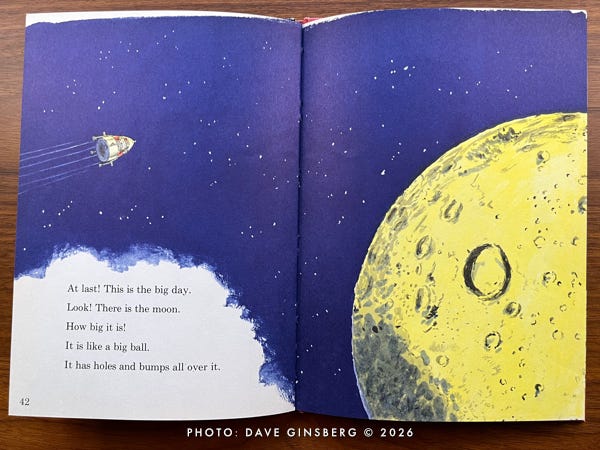
Onboard the Moonship, there are plenty of options available to pass the time.
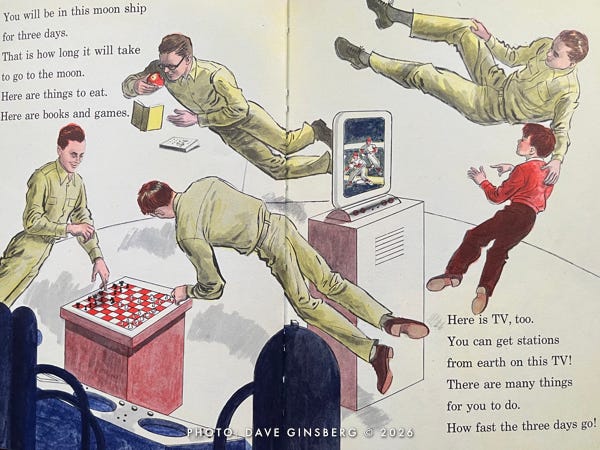
At last, the Moonship is about to land on the lunar surface!
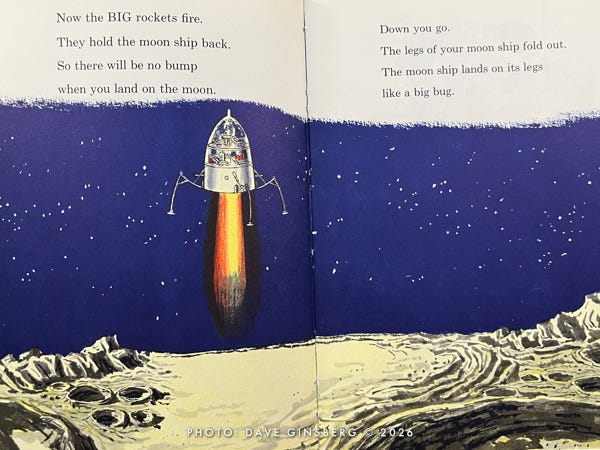
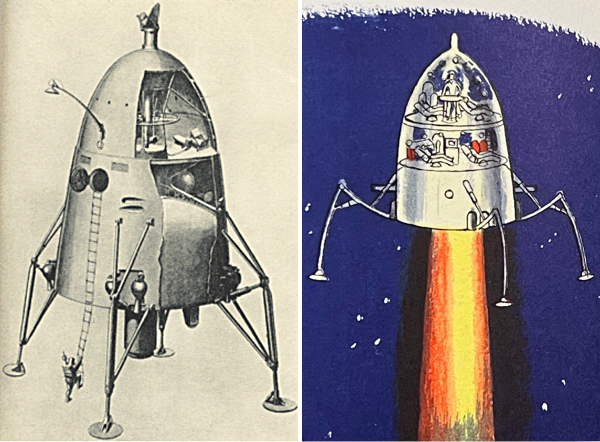
There are a couple of things to note about this lander.
First, it is pointed out in the book that, because of the look and function of its spindly legs, the craft resembles a bug. The Apollo Lunar Module (LM) was also sometimes referred to as a bug.
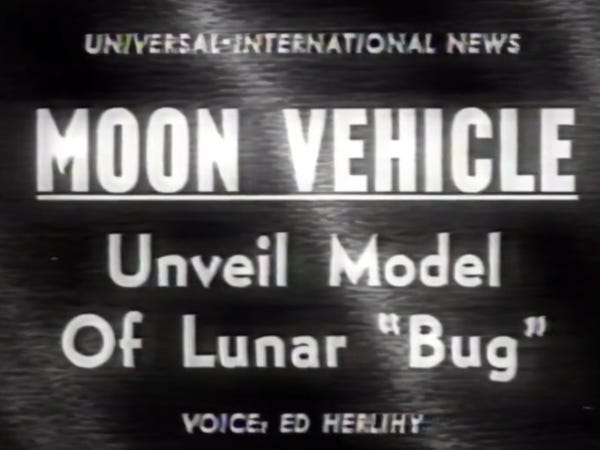
In fact, in what might be considered adding insult to injury, Volkswagen’s 1969 tongue-in-cheek self-deprecating advertisement strongly implied the LM was ugly.

Second, the book’s lander looks to have gained its inspiration from the British Interplanetary Society’s 1938 design for a ‘Lunar Spaceship’. I find it interesting, from an illustration standpoint, that the exterior views of the lander in the book are shown as cutaways, or perhaps with transparent domes. However, the interior views of the spacecraft show no windows at all. My guess is that the artist may have misinterpreted his reference materials.
Suited for Space
Once on the Moon, Little Davey is fitted with a custom-sized little spacesuit.
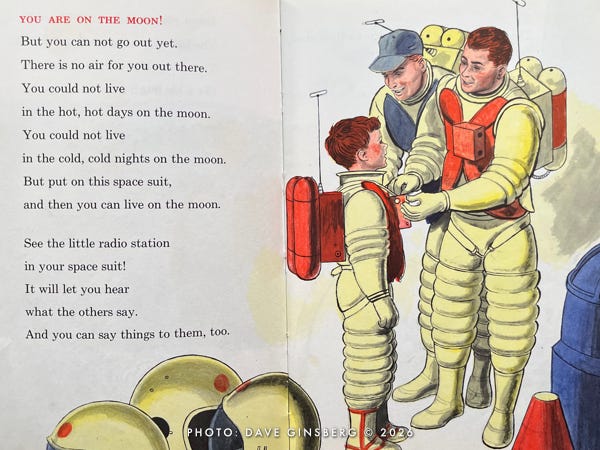
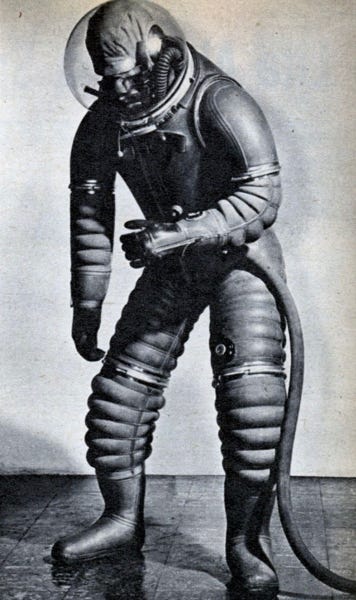
These spacesuits seem to derive their inspiration from a prototype pressure suit developed for the U.S Air Force around 1956. I think I’d be ready to get back to those cushy red couches after any length of time inside this tire inner tube.
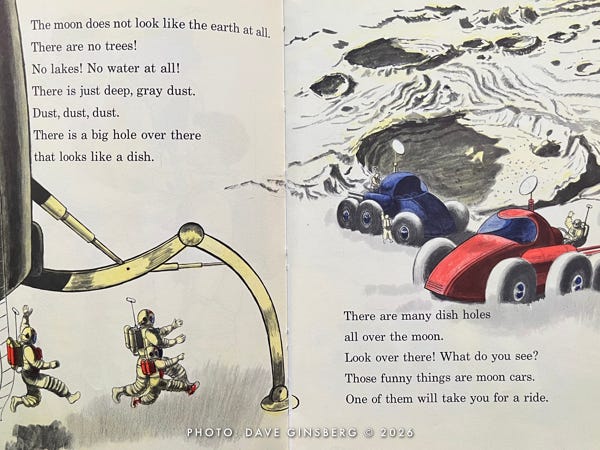
After descending the long rope ladder, the fun begins with a bouncy trek over to some awaiting moon cars. These appear to be quite luxurious, with fully-sealed cabins, sets of six fat off-road tires, and external communications dishes. Look closely and you will notice that the driver is seated outside at the rear of the vehicle. This seems to be the antithesis of luxury and almost assures he will be showered in kicked-up lunar regolith. I hope his helmet is equipped with good windshield wipers!
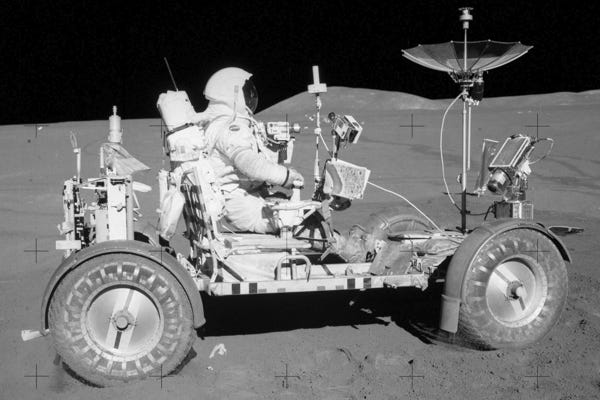
Setting the practicality of those moon cars aside for a moment, one has to give credit once more for predicting the future. The final three Apollo lunar landing missions, of course, brought cars with them – albeit somewhat more bare-bones in appearance, yet arguably more functional.
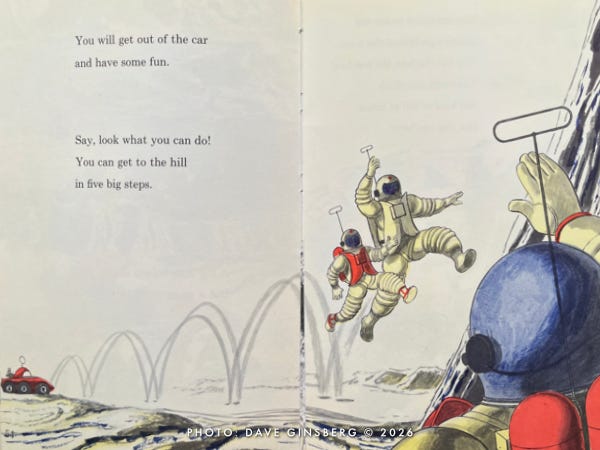
After the car ride, Davey takes several big bounds to see what is over the next hill. This particular scene of the two spacesuited figures joyously leaping over the Moon’s surface sticks in that place in my memory banks reserved for things that captured my imagination as a kid. I think more than anything else, it was the prospect of being able to effortlessly bounce around on the Moon that made me fantasize about one day being an astronaut.
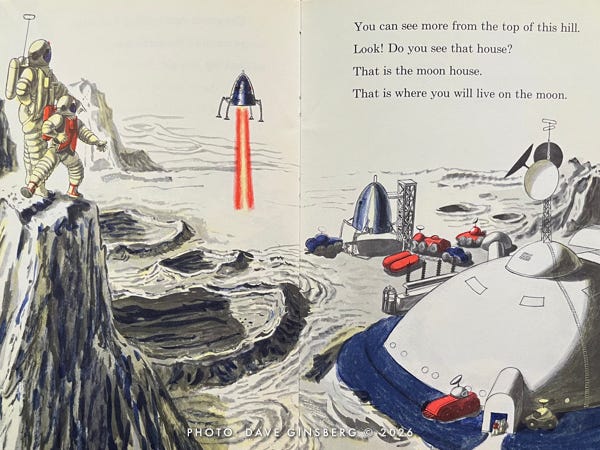
The view from (dangerously close to) the edge of the cliff is spectacular. We see that a lunar outpost has already been established in the valley, complete with a domed habitat, communications center, and launch and landing facilities.
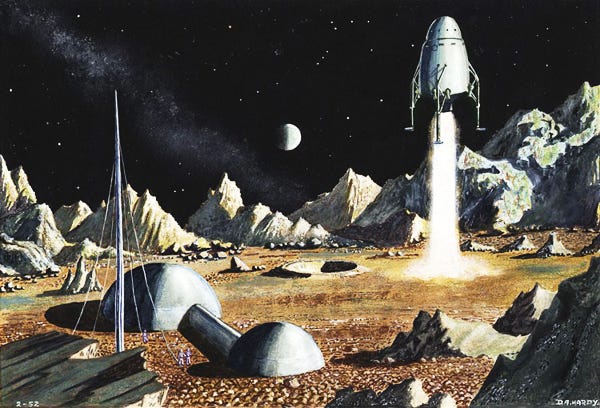
Paintings like this one done in 1952 by renown space artist, David Hardy, when he was only fifteen years old, may well have served as inspiration for the book’s moonbase scene.
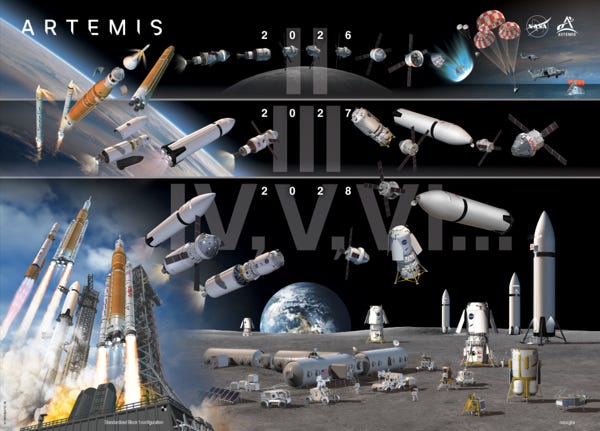
Contrast the illustrations from the 1950s with this rendering from March 2026. This illustration represents NASA’s current vision for the Artemis Program’s lunar base.
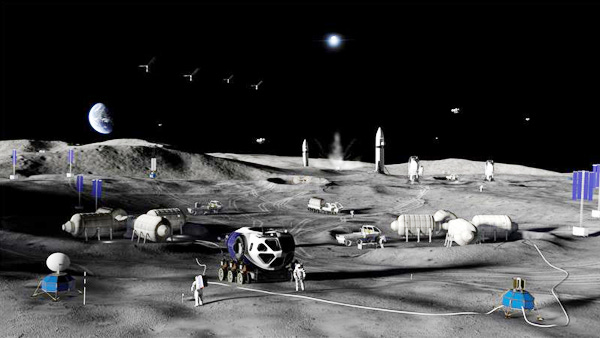
At the time of this writing, NASA recently announced extensive details about their plan to build a long-term presence on the Moon. Over the next few years, the plan builds upon the Artemis II lunar fly-by mission. Next up will be Earth-orbiting tests involving one or both of the lunar landers currently undergoing development and testing by SpaceX and Blue Origin. Then, in just under two years, the first attempt, for the Artemis Program, at landing a crew on the lunar surface will be made. Beyond that point, NASA and its international Artemis partners will take the first steps toward building the lunar outpost. As ambitious as this may seem, there is still the much larger goal of ultimately flying crewed missions to Mars.
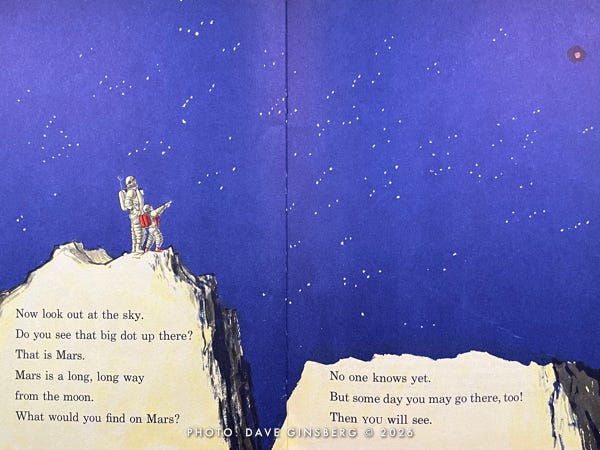
Much as NASA’s ultimate vision does, the book concludes with an eye toward Mars – the next destination for Little Davey ... and perhaps you will go there, too!

Art News
I am very happy that I will once again be exhibiting my space-inspired artwork at the U.S. Astronaut Hall of Fame Induction weekend events this year in Cocoa Beach, Florida. I will be joining notable space artists Chris Calle, Lee Wilson, and astronaut/artist Nicole Stott. This year will also feature artwork by Carlos Cardenas.
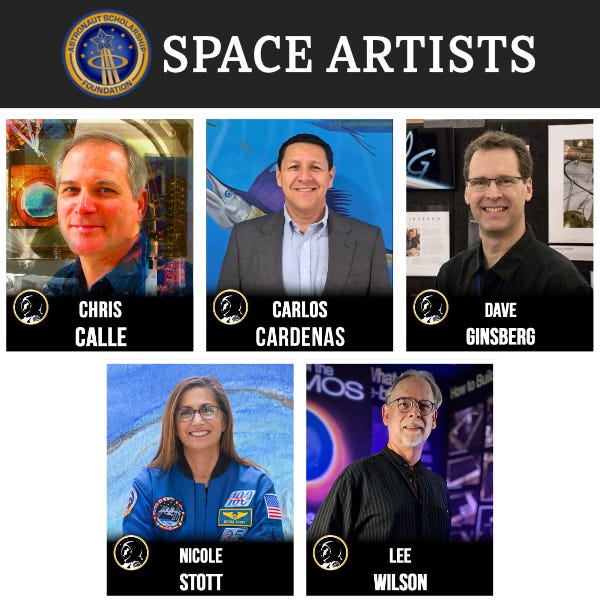
This year’s celebrations will be held from May 14 through 16, 2026. This will be my fourth time exhibiting at an ASF event.
The space art reception will run from 5:30 pm to 7:00 pm on Friday, May 15. It is open to the public and admission is free. The reception will take place in the Horizons Ballroom of the Hilton Cocoa Beach Oceanfront located at 1550 North Atlantic Ave, Cocoa Beach, Florida, 32931.
The events are organized by the Astronaut Scholarship Foundation (ASF), a non-profit organization that provides scholarships to the brightest and most talented college students in science, technology, engineering and mathematics.8 I am proud to be able to support the ASF in their educational mission. A portion of my sales proceeds will go directly to the ASF organization.
Merch of the Month
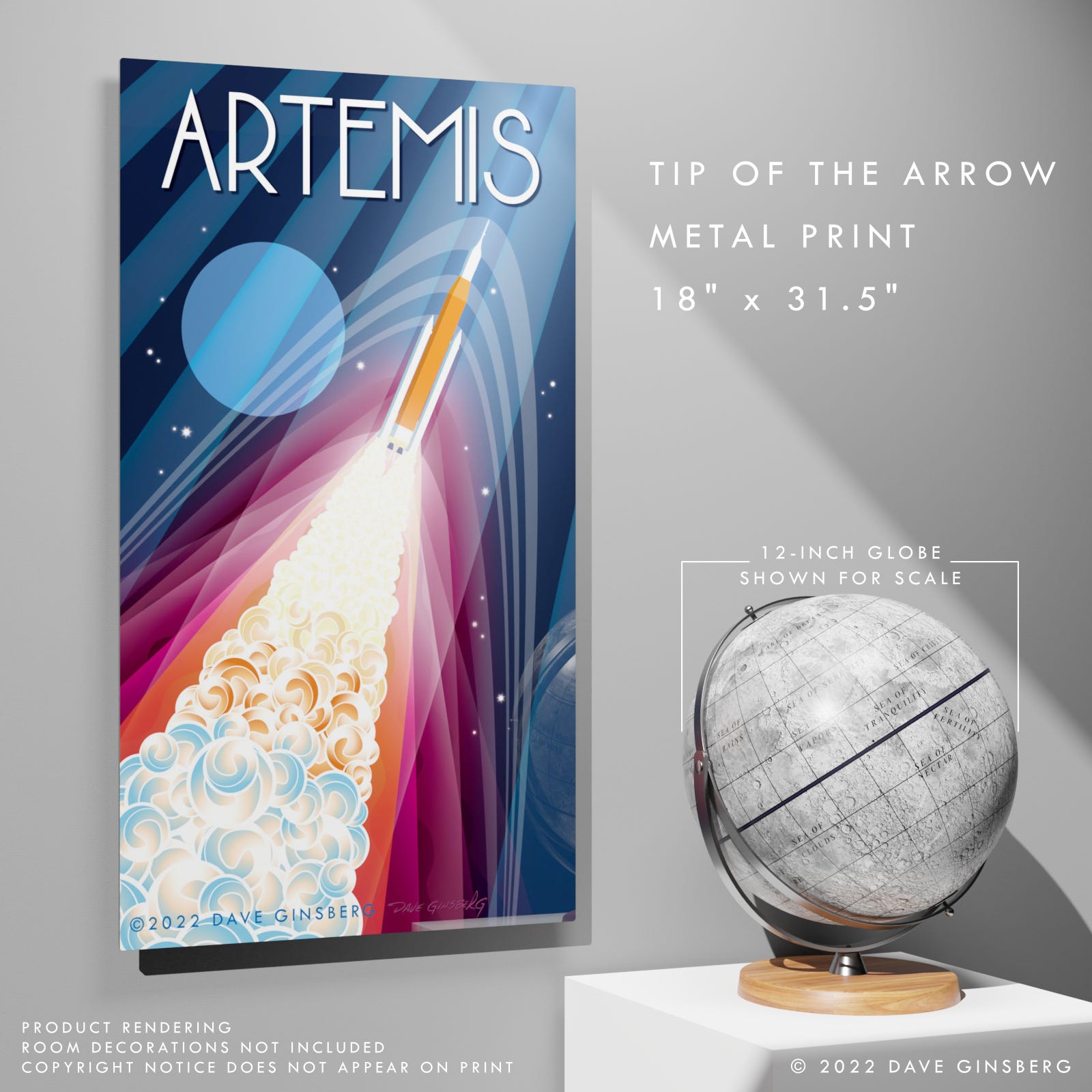
Tip of the Arrow (Artemis I Launch) Metal Print
If you’re going to go to the Moon, sooner or later you’ve got to get an Artemis rocket.
SOCIAL IMPACT
Your purchase from Pixel Planet Pictures helps support and promote space-related STEAM organizations and initiatives that enable and inspire students and youth to learn, develop, and pursue passions in science, technology, engineering, arts, and math.


I'm Dave Ginsberg, the artist behind Pixel Planet Pictures and writer of Creating Space.
I am an artist and a creative engineer with a love for teaching and passions for spaceflight, astronomy, and science. My space-inspired art portfolio can be found at pixel-planet-pictures.com.

Do you know fellow Space Geeks who might enjoy Creating Space? Invite them into this space, too!
Did you miss a post? Catch up here.

If you enjoyed this article please hit the ‘Like’ button and feel free to comment.

All images and text copyright © Dave Ginsberg, unless otherwise noted. All rights reserved.
Multistage rocket, https://en.wikipedia.org/w/index.php?title=Multistage_rocket&oldid=1339429700 (last visited Apr. 19, 2026).
Huolongchushui, https://en.wikipedia.org/w/index.php?title=Huolongchushui&oldid=1322301411 (last visited Apr. 19, 2026).
All About Water Rockets, Timeline – Brief History of Rocketry, 13th Through 16th Centuries, NASA Glenn Research Center (https://www.grc.nasa.gov/www/k-12/rocket/BottleRocket/13thru16.htm)
75 Years Ago: First Launch of a Two-Stage Rocket, NASA Johnson Space Center (https://www.nasa.gov/history/75-years-ago-first-launch-of-a-two-stage-rocket/)
Saving Intelsat VI: Creative Problem-Solving on Endeavour, STS-49, Tom Jones, October 12, 2023 (https://astronauttomjones.com/2023/10/12/saving-intelsat-vi-creative-problem-solving-on-endeavour-sts-49/)
Movies and TV shows onboard the International Space Station, IMDb (https://www.imdb.com/list/ls507438358/)
EYES TURNED SKYWARD, APOLLO MOON MISSION QUOTES (https://www.eyesturnedskyward.com/apollo.html)
My mom read me "You Will Go to the Moon" during the months leading up to Apollo 11 and I revisited the book many times in elementary school as I awaited (and still await) spinning artificial gravity space stations. As I scrolled through your article, each image from the book popped out at me -- exactly as I had remembered. Thank you for the trip down memory lane.
Impressive. And intriguing about the previous owner of the book. I found it poignant when you said Little Davey would have been 19 in 1968. Vietnam came to mind. I hope he made it through.