

Creating a Place for Air and Space
The origin story of the Smithsonian National Air and Space Museum


Exploring the intersection of spaceflight history, pop culture, and space art.
The National Air and Space Museum played an important part in nurturing my interests in aviation and spaceflight. It fed my curiosity and wonder about all things flight, and inspired me in my aerospace engineering career as well as my artwork and writing.
I grew up just outside of Washington, D.C., and school field trips to the Smithsonian were not out of the ordinary. Throughout my life, I visited the National Air and Space Museum whenever I got the chance. In fact, I was there so often I jokingly refer to it as my second home.
So, it is with great pleasure and a sense of nostalgia that I help celebrate the fiftieth anniversary of the museum’s building on the National Mall by presenting the origin story of the National Air and Space Museum.
Are you new to Creating Space? It’s the NERDSletter that explores the intersection of spaceflight history, pop culture, and space art. You can find this and all other posts at creating-space.art.
How to Create a Museum Out of Thin Air
On July 1, 1976, the Smithsonian National Air and Space Museum (NASM) held the grand opening of its flagship building on the National Mall in Washington, D.C., gifting the nation a brand new building and presenting to visitors countless artifacts not previously displayed that told the story of aviation and spaceflight history in a brilliant new light.
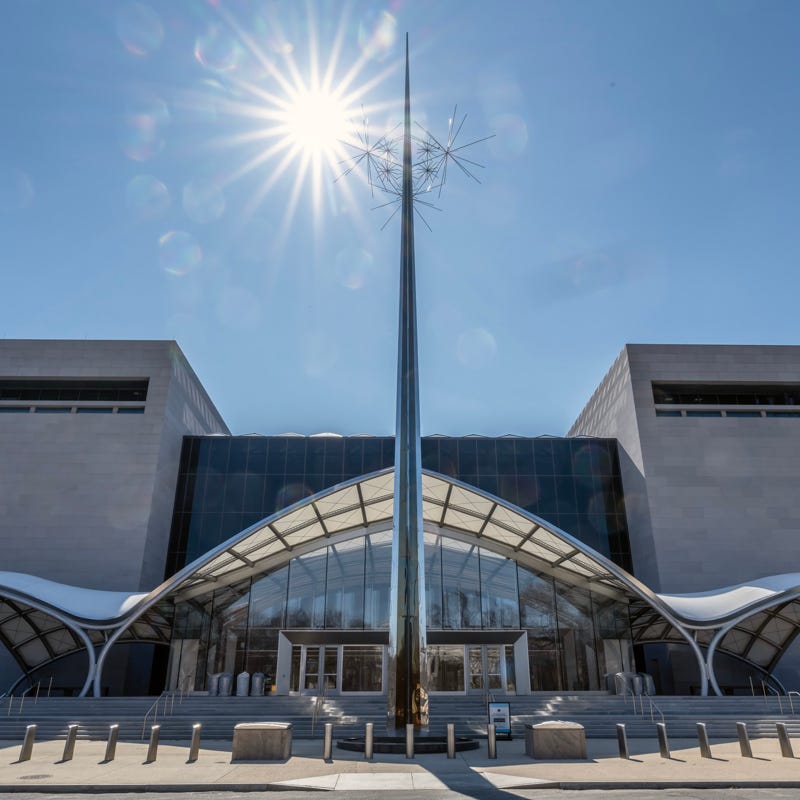
Where were these treasures kept before then, and how did this new building come to be? As the fiftieth anniversary of the National Air and Space Museum approaches, let’s look back on how it all began.
“An establishment for the increase and diffusion of knowledge among men”
Let’s begin at the beginning – before there were any aircraft, or certainly spacecraft, to be seen – even before there was a museum of any sort for the nation.
James Smithson was an English chemist and mineralogist. He had inherited some amount of wealth from his mother’s family. Having never married, himself, he stipulated in his will that if his nephew and sole heir died without heirs of his own, his estate should go to the United States “to found at Washington, under the name of the Smithsonian Institution, an establishment for the increase and diffusion of knowledge among men.”12
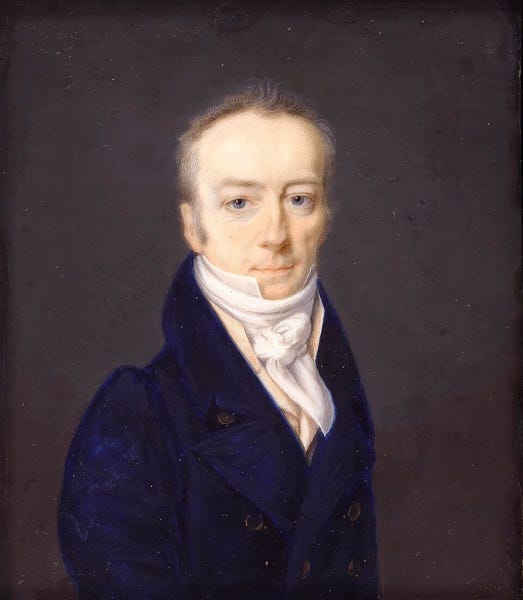
In 1829, James Smithson passed away, leaving his estate to his nephew, Henry James Hungerford, who died six years later having never had any children. And so it was that James Smithson’s bequest to the United States, which he had never visited, became the seed for what was to become the premier family of museums, research and education centers, in the nation.
Eleven years later, in 1846, after much debate in Congress centering around whether or not the federal government could, or even should, accept such a donation from a foreigner, legislation was passed officially founding the Smithsonian Institution as an establishment dedicated to the "increase and diffusion of knowledge".3
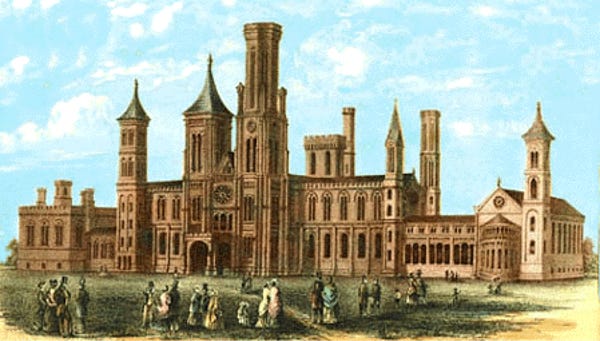
The next order of business was to build a physical home for the institution. Thus, was born the “Castle”, an ornate multi-story, red sandstone brick clad, building designed in the Norman style (a 12th-century combination of late Romanesque and early Gothic motifs) by James Renwick, Jr.45 Construction was completed in 1855 in a remote parcel of land in Washington, D.C., that would eventually become the central feature of the National Mall, around which the Smithsonian’s physical presence would expand into several additional museums and galleries – one of which would be the National Air and Space Museum.
But, I am getting ahead of myself.
Arts and Industries
It would be another two years before the institution named for James Smithson would be designated as a museum – the ‘National Museum of the United States’, to be precise.
To house the nation’s new collection of old collectables, a new building was built and opened in 1881. Initially known simply as the ‘National Museum Building’ (not to be confused with the National Building Museum6), it would come to be known as the ‘Arts and Industries Building’.
The architectural style of the Arts and Industries Building complimented the main Castle with its ornate towers and steeples, gothic windows, a large drum-shaped cupola, and dark red brick exterior. It was designed with a wide, one-story Greek cross plan, a large central rotunda, and an iron truss roof allowing expansive, uninterrupted exhibit spaces.7
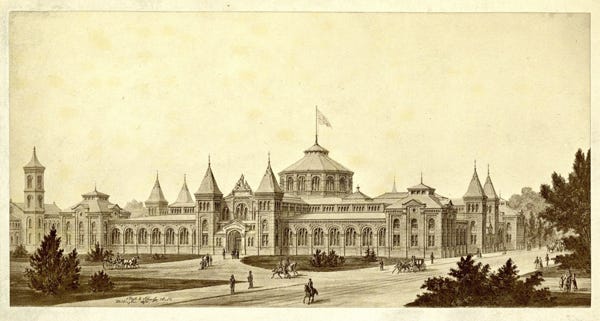
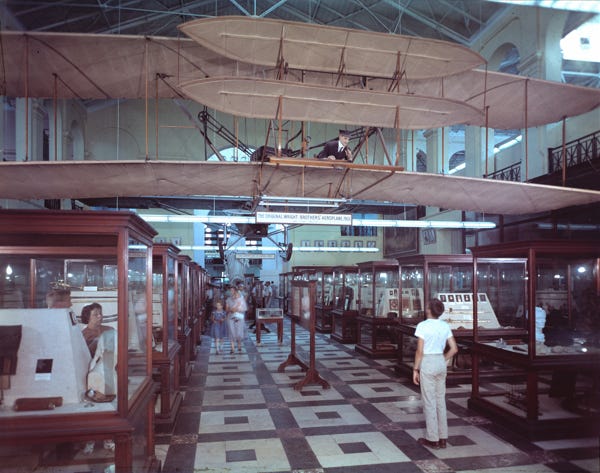
Eventually, the Arts and Industries Building would house several aerodromes built by Samuel P. Langley, the Wright Flyer, and Charles Lindbergh’s Spirit of St. Louis.
But, again, I’m getting ahead of myself.
Earliest Acquisitions
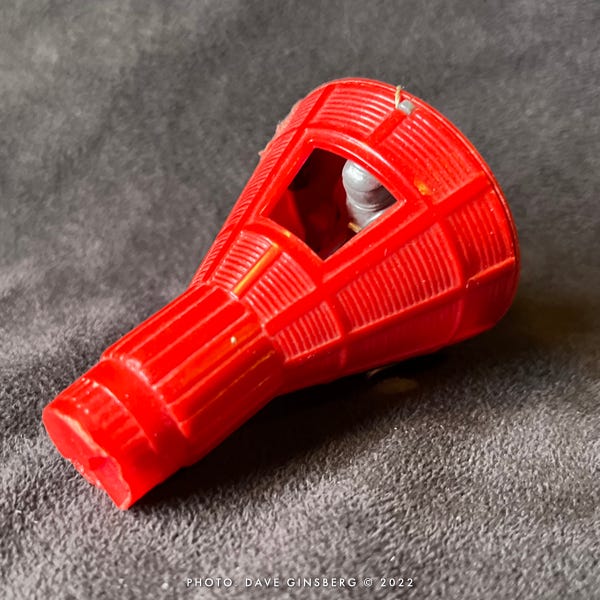
Every air and space collection has to start with something. For me, my first space collectible may have been this Mercury capsule toy that I played with when I was a kid.
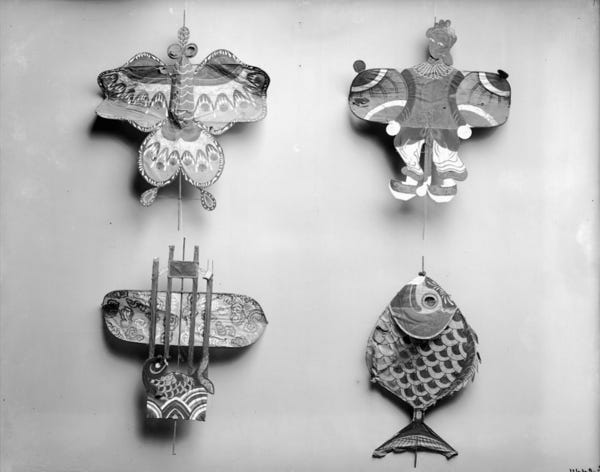
For the Smithsonian, it was a group of forty-three kites donated in 1876 from the Chinese Imperial Commission. The kites were some of the materials given to the Smithsonian after they were displayed at the 1876 Centennial Exposition in Philadelphia. Twenty of the kites would eventually be transferred to the collection of the National Air and Space Museum.8
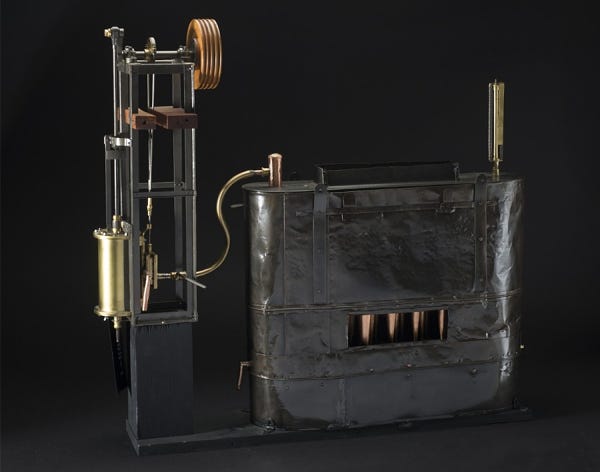
The first item officially accessioned into the National Air and Space Museum’s catalog was a steam engine build by John Stringfellow. The engine powered a triplane model along a cable at an exposition in 1868 in London's Crystal Palace.910
In the 1890s, the only space travel being done was through the eyepiece of a telescope. In that sense, one could claim that space made its first appearance in the Smithsonian in 1890 when the Astrophysical Observatory was established and housed in a group of small structures on the grounds south of the main Smithsonian Institution Building, an area that would come to be known as the South Yard.11
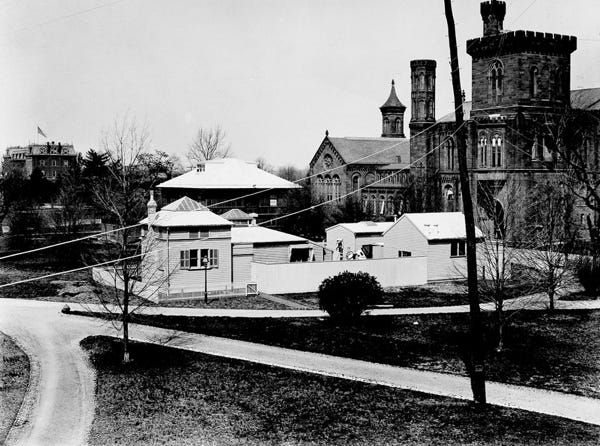
The South Yard
The South Yard of the main Smithsonian Institution Building would one day be used as the location of the first dedicated building for the museum’s future collection of airplanes. But, not before a number of other residents would call the Castle’s backyard home.
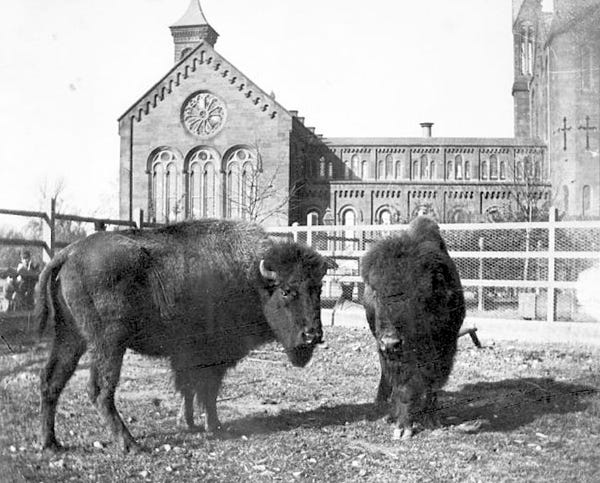
For instance, take these two buffalo ... please ... may have been the words uttered when the Smithsonian’s chief taxidermist and spokesman for the conservation movement, William T. Hornaday, introduced the pair of American Bison to the South Yard in 1886. These and other wild North American animals (a bear, an eagle, badgers) comprised the original exhibition of the Department of Living Animals prior to the establishment of the National Zoo in 1889. Live exhibits gave Smithsonian taxidermists an opportunity to observe the habits and positions of various animals and to use this knowledge in mounting collections and exhibitions.1213
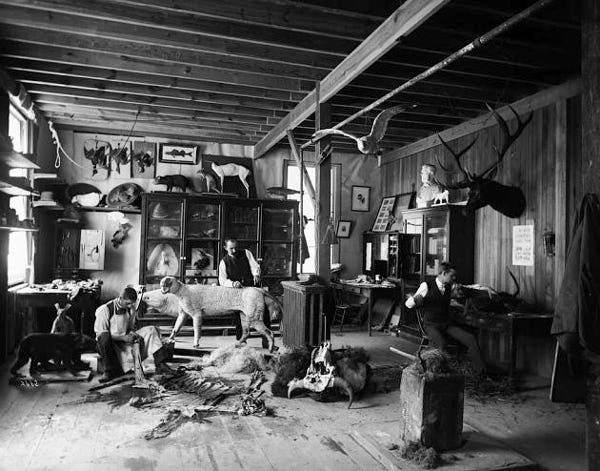
Said taxidermy for the preparation of exhibition specimens was performed in a building called the ‘South Shed’, also referred to as the ‘Annex’, which was built in 1898. It would later be used as the ‘Bug House’.14
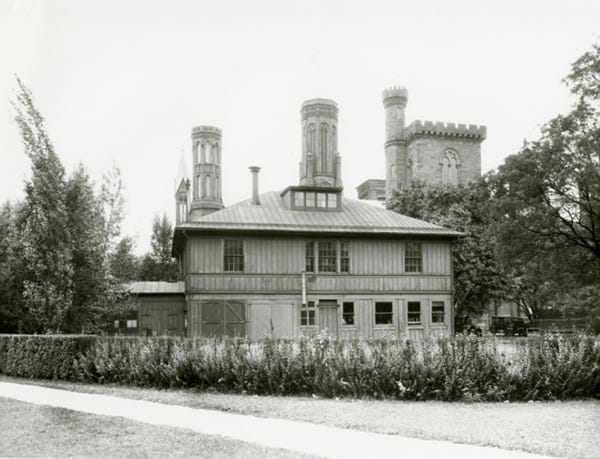
Here we see chief taxidermist, William T. Hornaday, working on a tiger mounted for exhibit and Andrew Forney is working on the tiger skin.15 You didn’t think all those animals in the Museum of Natural History stuffed and mounted themselves, did you?
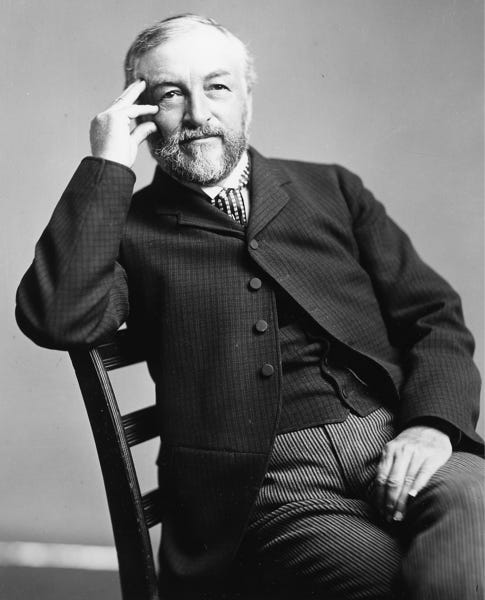
In 1887, Astrophysicist Samuel Pierpont Langley was elected the third secretary of the Smithsonian Institution. He was the founder of the Astrophysical Observatory, seen earlier, as well as an early aviation pioneer. Here we see Samuel apparently trying to remember where he put the keys to his aerodrome.
Langley did much of his aviation pioneering in a shed in the South Yard that was known as, appropriately enough, the Aerodrome Shop.
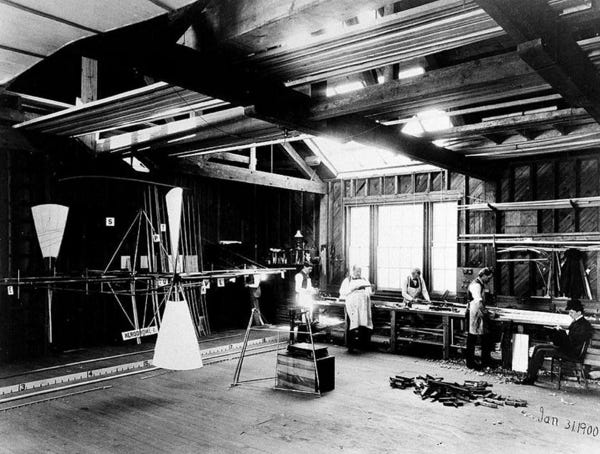
Langley’s aeronautical experiments at the Smithsonian led to a juicy story of museum drama ...
Although he was somewhat successful in obtaining funding from the U.S. government to develop a piloted airplane – based upon his experiments with unpiloted aerodromes – Langley never did quite achieve the goal of sustained and controllable piloted flight. Nevertheless, Langley’s aerodrome would be displayed in the Smithsonian along with the claim that it was "the first man-carrying aeroplane in the history of the world capable of sustained free flight".16 This claim, of course, was vehemently disputed by Orville and Wilbur Wright.
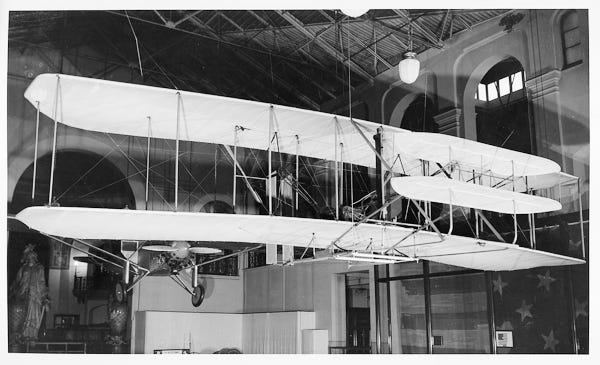
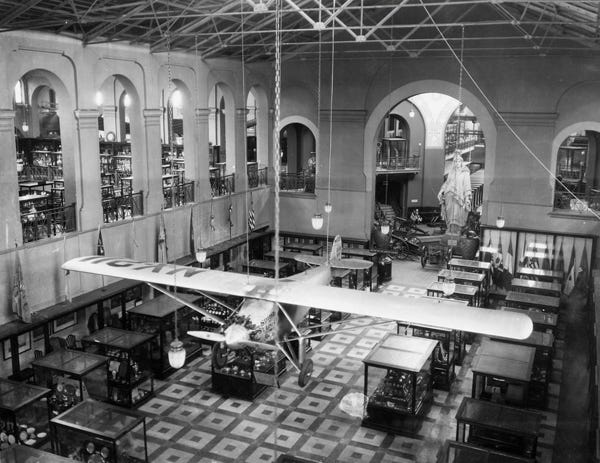
The dispute prompted Orville to initially refuse to allow the Flyer to be displayed in the Smithsonian, opting instead to loan it to the Science Museum in London. It was not until 1942 that the Smithsonian “clarified” the contributions and capabilities of Langley’s Aerodrome. Then, finally in 1948, the Wright Flyer was brought back to the United States and hung in a place of prominence in the Smithsonian Arts and Industries Building in front of the Spirit of St. Louis.17 I still have vague memories of going to the Smithsonian in the 1960s and being enthralled by the sight of those two original airplanes positioned as if flying in tandem.
The National Air Museum
As time went on, and advances in aviation accelerated, the Smithsonian found itself the beneficiary of those advances in the form of more and more airplanes of historical significance. By the end of the first World War, the collection had grown to a point that exceeded the Institution’s capacity to house and display it.18
A separate Aircraft Building would become the answer to this growing embarrassment of flying riches. A metal Quonset hut, known as the ‘Tin Shed’19, would serve as the somewhat inglorious first home for the expanding aeronautical fleet. The structure had been erected in the South Yard behind the Castle in 1917 by the United States Signal Service for use during World War I.20
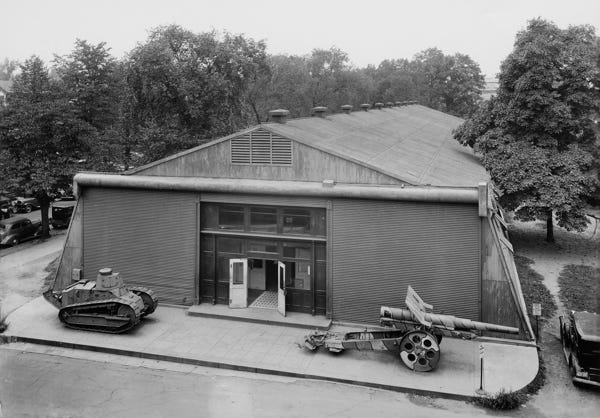
The National Air Museum wouldn’t become official until 1946 when President Harry S. Truman signed the Act, which stated that “the new museum shall memorialize the national development of aviation; collect, preserve, and display aeronautical equipment of historical interest and significance; serve as a repository for scientific equipment and data pertaining to the development of aviation; and, provide educational material for the historical study of aviation.”21
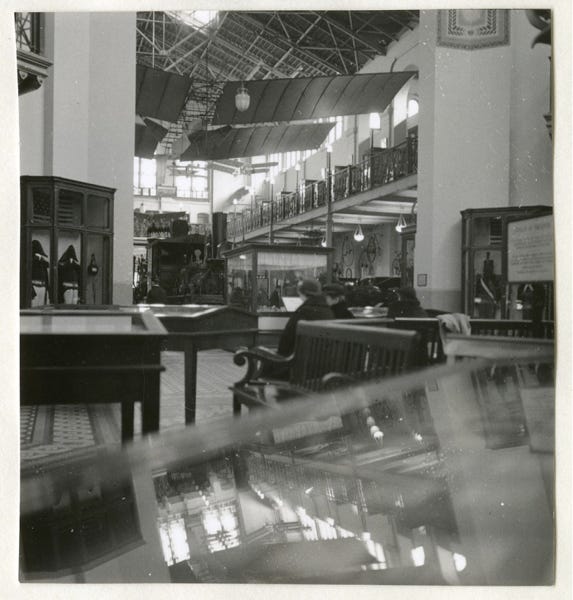
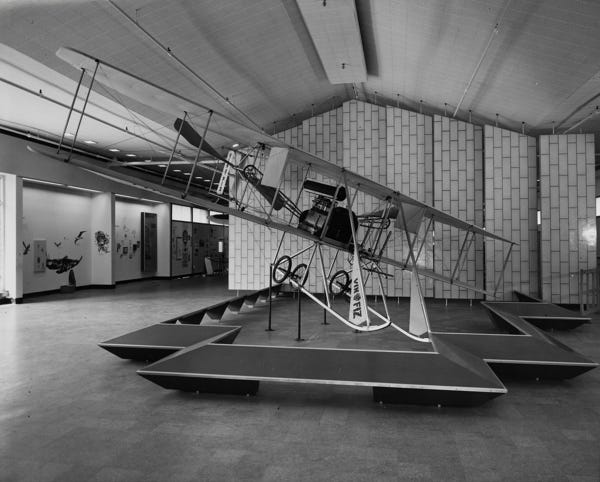
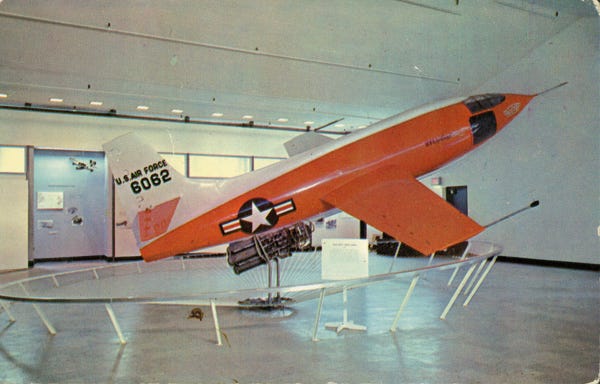
Here are a few photographs showing some of the exhibits and artifacts that were housed inside.
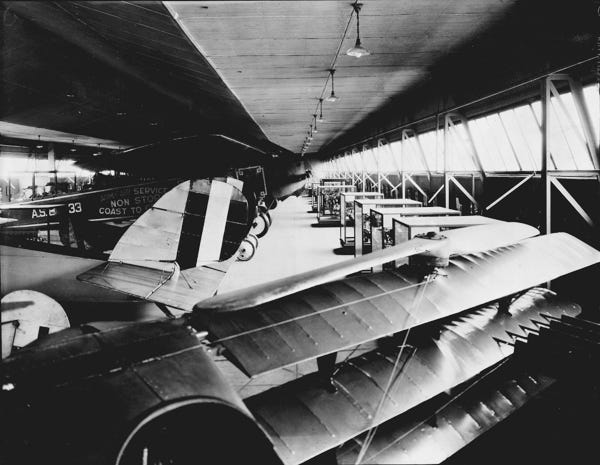
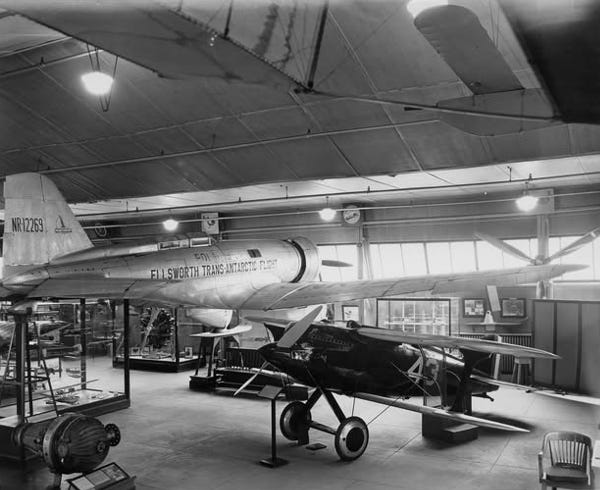
Adding Space
The United States had entered the Space Age with its 1958 launch of a modified Jupiter-C sounding rocket22 which succeeded in orbiting a satellite named Explorer I. This first for the U.S. would be followed by a rapid succession of achievements in space worthy of highlighting in the Smithsonian’s collection. The National Air Museum took on the mission to display the space vehicles and to tell their stories.
As such, the Aircraft Building began to make room for space. But, what about that name?
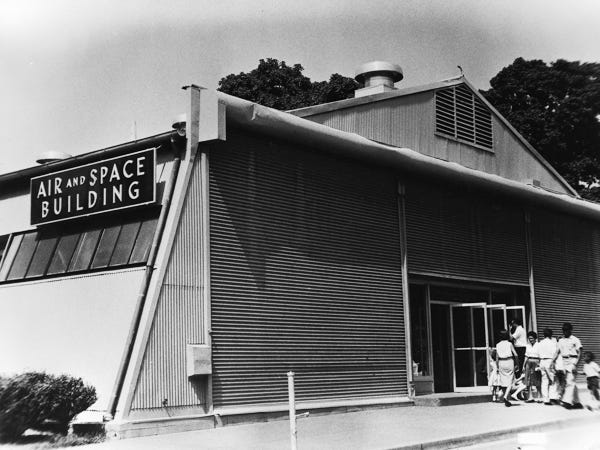
As the space available inside the Aircraft Building began filling up with spacecraft, it was natural to consider changing the name of the building to reflect that fact. And so, in 1961, the name was officially changed to the Air and Space Building and a new sign replaced the old one.
Just look at that awesome Art Deco typeface!
Prior to the building’s name change, the Smithsonian had already begun building a collection of rockets and missiles. The Institution had provided funding in 1916 for Robert Goddard’s rocket experiments, and had acquired a Goddard rocket in 1936.
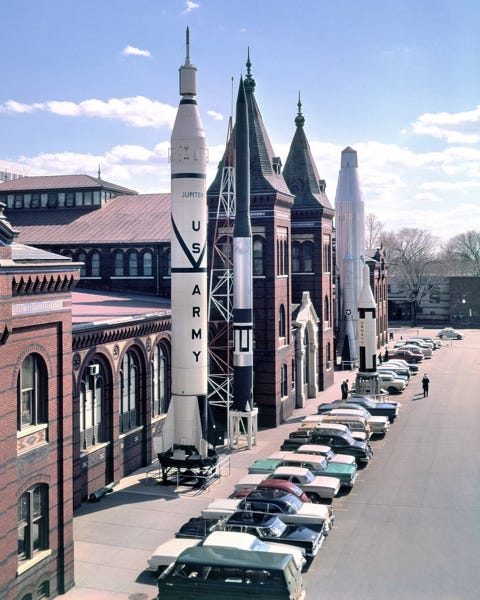
Shortly after the successful orbiting of Explorer I, several missiles were erected outside along the west side of the Arts and Industries Building. One of my earliest childhood memories of visiting the Smithsonian is excitedly running down the street to get my first up-close view of these towering beasts.
Inside the Arts and Industries Building rotunda was a large exhibit about communications and environmental satellites featuring a world globe enveloped in representations of spacecraft orbits and surrounded by models of their launch vehicles.
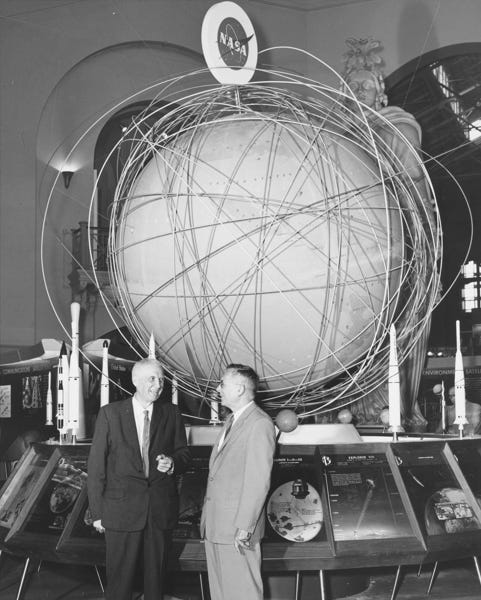
While the larger space artifacts and exhibits were being hosted in the more spacious Arts and Industries Building, the Air and Space Building was taking on some of the items that demanded less space.
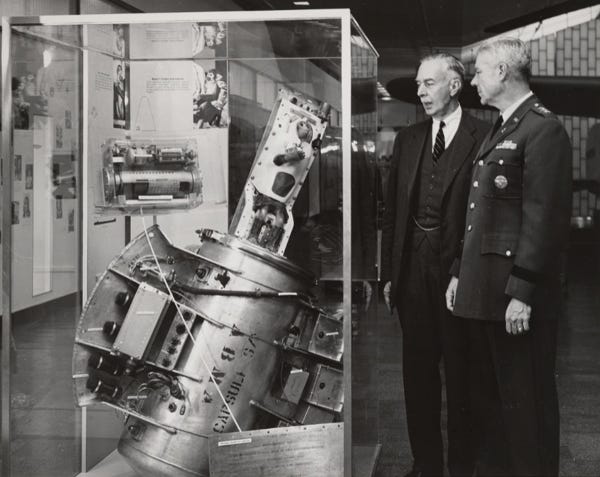
Here’s an exhibit containing the space flight equipment used to send a rhesus monkey named Able on a suborbital flight aboard a Jupiter rocket along with a squirrel monkey named Baker. The preserved body of Able is seen encased in her protective harness atop the assembly.
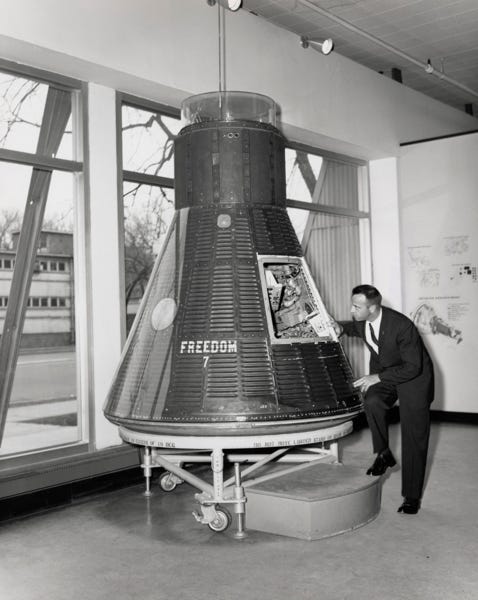
Alan Shepard’s Freedom 7 Mercury space capsule made its first appearance in the Air and Space Building in 1961. Here’s Alan, himself, apparently checking to see if he left anything behind.
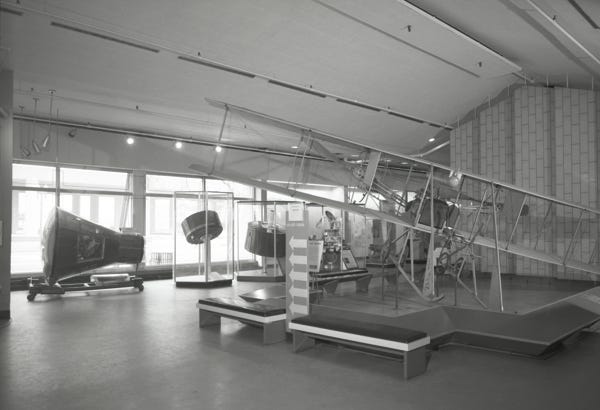
Here, juxtaposed with the 1911 Vin Fiz Wright EX biplane, is John Glenn’s Friendship 7 Mercury capsule, a Tiros weather satellite, and other early satellites.
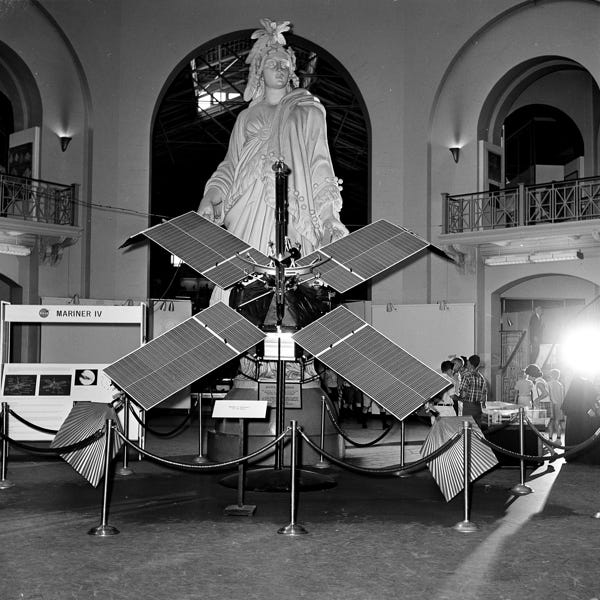
As time went on, larger space exhibits continued to be placed inside the Arts and Industries Building. In 1965, a full-sized model of Mariner IV was placed on exhibit in the rotunda. Mariner IV performed the first successful flyby of the planet Mars, returning the first close-up pictures of the Martian surface.23
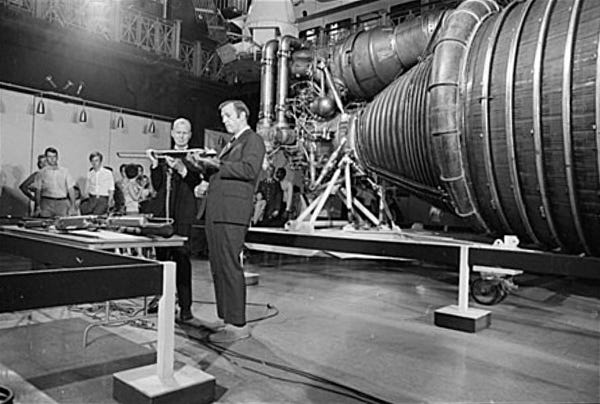
By 1969, the Smithsonian’s space acquisitions were starting to stretch the capacity of the available space. During the Apollo 11 lunar landing mission, they managed to squeeze into the Arts and Industries Building some unused engines from the Apollo Saturn V, including an F-1 from the first stage booster.
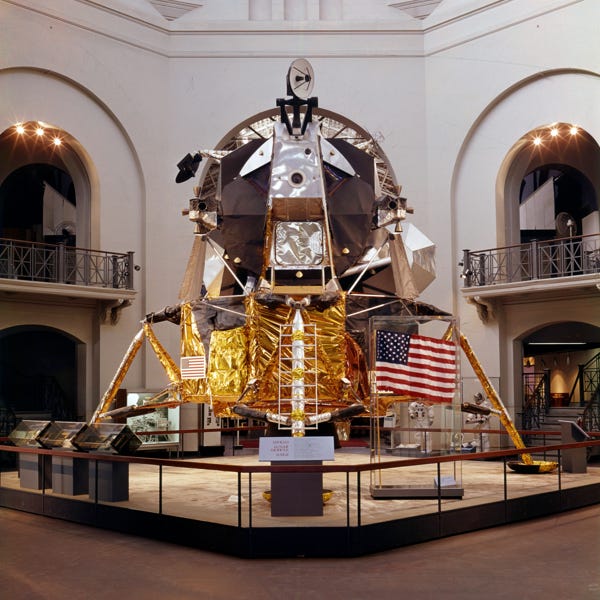
An Apollo Lunar Module (LM-2) was brought into the Arts and Industries Building rotunda in the latter part of 1970, dressed as Apollo 11’s Eagle. Imagine walking up to see this inside such a beautiful setting.
And, Columbia, the actual Command Module used on Apollo 11, took its rightful place next to the Lunar Module, after it concluded its nationwide road trip.24
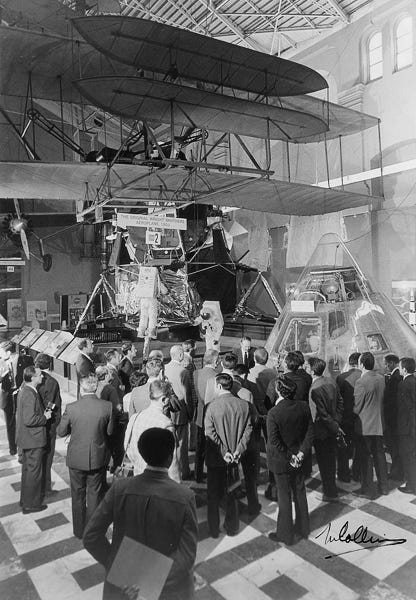
To give you an idea of how crowded the Arts and Industries Building was getting with all these large air and space artifacts, take a look at this photograph taken in 1973. Here we see two Wright airplanes (the original 1903 Flyer and a 1909 Military Flyer), the Spirit of St. Louis, the flown Gemini IV capsule (with a mannequin of Ed White exiting the hatchway for his historic space walk), the Apollo 11 Command Module Columbia, and Lunar Module LM-2.
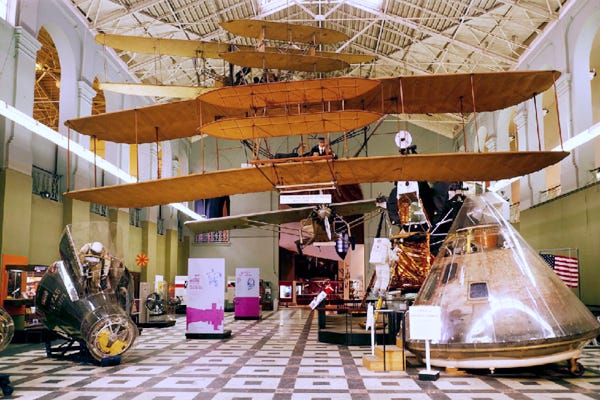
Many of these historic air and space objects would soon find themselves together in the Milestones of Flight gallery in the new National Air and Space Museum building that would soon be completed on the National Mall.
But, once again, I am getting slightly ahead of myself.
Wait! There’s more space to come!
The story doesn’t end here – in fact, it is just beginning.
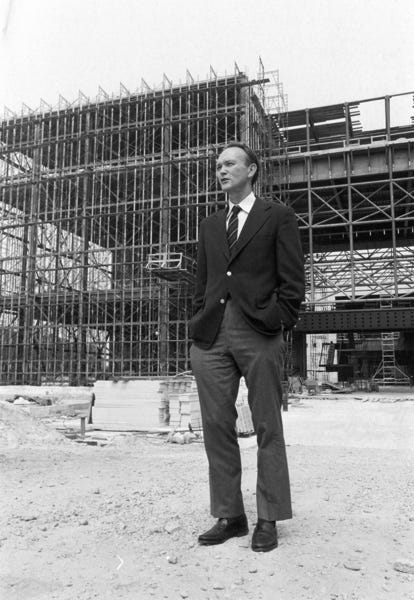
In the next issue of Creating Space, I will be sharing some rarely-seen photographs from the Smithsonian Institution Archives of some early designs for the new museum building, its construction, and the transfer of some of the artifacts from the old buildings to the new galleries. And we will learn of the role astronaut Michael Collins played in seeing it through to a grand opening ahead of schedule.
So, watch this space!

Art News

Next month I will be returning to Tucson to participate as an artist in the ‘Spacefest Continues’ gathering. Eight other artists are currently scheduled to attend the event which includes astronaut talks, book author discussions, and a side trip or two to one of the local space-related places in and around the city.
The first Spacefest was held in 2007, organized by space artist Kim Poor, his extended family, and the good people at his space art and collectibles business, Novaspace Art. Since then, the event had been held yearly with just a few exceptions through 2021. The COVID-19 outbreak caused a suspension for several years.
In 2025, some enthusiastic friends of Novaspace and fans of Spacefest arranged a small-ish reunion at the Marriott Starr Pass Resort, where the majority of the previous events had been held. They called it, appropriately enough, the ‘Friends of Spacefest Reunion’.
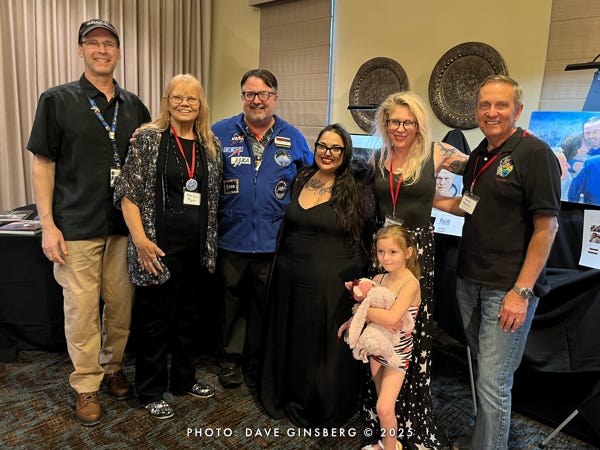
So successful and well-received was that event, this year they are planning another one – this time called ‘Spacefest Continues.’ This year’s event promises to be even bigger and better than last year’s. So far, there are five former astronauts scheduled to attend, over a dozen space authors, as well as the nine space artists.
I have displayed my artwork at five Spacefest events, including the 2025 ‘Friends of Spacefest Reunion’. ‘Spacefest Continues.’ will be my sixth.
The event will be held July 23 through 25, 2026 at the University of Arizona in Tucson. See the website and Facebook group for the latest updates.
Merch of the Month
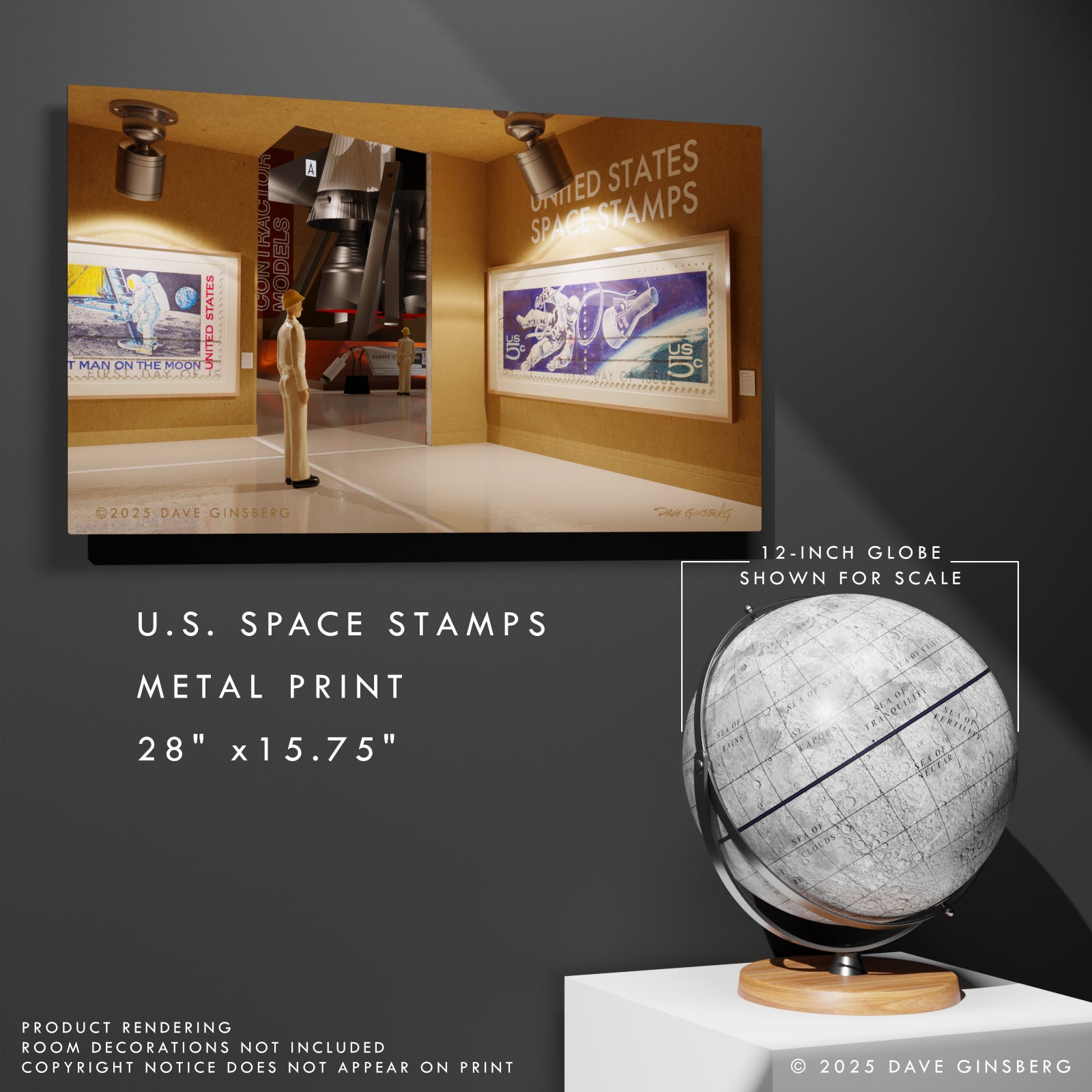
U.S. Space Stamps Metal Print
Add a little museum to your home or office with this whimsical scene of miniature technician figures from the George C. Marshall Space Flight Center (MSFC) Graphic Engineering and Models Branch viewing space art stamps and contractor models in a tiny museum gallery.
SOCIAL IMPACT
Your purchase from Pixel Planet Pictures helps support and promote space-related STEAM organizations and initiatives that enable and inspire students and youth to learn, develop, and pursue passions in science, technology, engineering, arts, and math.


I'm Dave Ginsberg, the artist behind Pixel Planet Pictures and writer of Creating Space.
I am an artist and a creative engineer with a love for teaching and passions for spaceflight, astronomy, and science. My space-inspired art portfolio can be found at pixel-planet-pictures.com.

Do you know fellow Space Geeks who might enjoy Creating Space? Invite them into this space, too!
Did you miss a post? Catch up here.

If you enjoyed this article please hit the ‘Like’ button and feel free to comment.

All images and text copyright © Dave Ginsberg, unless otherwise noted. All rights reserved.
James Smithson, Britannica Editors, Britannica (https://www.britannica.com/biography/James-Smithson)
General History, Smithsonian Institution Archives (https://siarchives.si.edu/history/general-history)
Smithsonian Institution Archives
Smithsonian Institution Archives
Smithsonian Institution Building, The Castle, Smithsonian Institution Archives, (https://siarchives.si.edu/history/smithsonian-institution-building-castle)
National Building Museum (https://nbm.org/)
Arts and Industries Building, National Park Service (https://www.nps.gov/places/arts-and-industries-building.htm)
What Were the First 10 Items In the Smithsonian’s Air and Space Museum?, Smithsonian Air & Space Magazine, Rebecca Maksel, August 23, 2017 (https://www.smithsonianmag.com/air-space-magazine/first-ten-180964539/)
Smithsonian Air & Space Magazine
Stringfellow Steam Engine, National Air and Space Museum (https://airandspace.si.edu/collection-objects/stringfellow-steam-engine/nasm_A18890001000)
Smithsonian Timeline, Smithsonian Institution Archives (https://siarchives.si.edu/history/smithsonian-timeline)
Department of Living Animals, Smithsonian Institution, Histories of the National Mall (https://mallhistory.org/items/show/233)
Buffalo behind Smithsonian Institution Building, Histories of the National Mall (https://mallhistory.org/items/show/260)
The South Yard, Smithsonian Institution Archives (https://siarchives.si.edu/history/historic-pictures-smithsonian/south-yard)
Smithsonian Institution Archives
Samuel Langley, https://en.wikipedia.org/w/index.php?title=Samuel_Langley&oldid=1350295538 (last visited June 8, 2026).
Langley Aerodrome A, National Air and Space Museum (https://airandspace.si.edu/collection-objects/langley-aerodrome/nasm_A19180001000)
A History of National Air and Space Museum, Media Fact Sheet, Alison Wood, June 28, 2016 (https://www.si.edu/newsdesk/factsheets/national-air-and-space-museum-history)
Media Fact Sheet, Alison Wood
The South Yard, Smithsonian Institution Archives (https://siarchives.si.edu/history/historic-pictures-smithsonian/south-yard)
Smithsonian Timeline, Smithsonian Institution Archives (https://siarchives.si.edu/history/smithsonian-timeline)
Juno I, https://en.wikipedia.org/w/index.php?title=Juno_I&oldid=1357485274 (last visited June 15, 2026).
Mariner 4, https://en.wikipedia.org/w/index.php?title=Mariner_4&oldid=1353183895 (last visited June 16, 2026).
January 29, 1971: Apollo 11’s Columbia lands in Montgomery, Alabama, Brian Odom, NASA Marshall Space Flight Center (https://www.nasa.gov/history/january-29-1971-apollo-11s-columbia-lands-in-montgomery-alabama/)
Hi Dave,
Those art works you mentioned would be a great adventure if you were still in the area. Well neither of us are. I'm in Raleigh, NC now. Financially I still have a ways to go but now that I'm back working I am hoping that soon I can buy some of your prints. Money is now tight vs in the hole! LOL! Yes that Rockville facility is what I was referring to. The artifact that stood out for me was the APOLLO spacecraft apex cover. Beats me why!! LOL!!!!
Hello Dave!,
Wow what a great story on the Smithsonian history! So much cool stuff I did not know! I knew about the A & S Museum coming and Michael Collins being named the curator. Missile Row was pretty cool! What memories! I remember a field trip from my school in NoVa, Belvedere E.S. in '65 to the Smithsonian museums. That was a cool trip! The trees were just being planted lining the mall grass way now know as The Mall.
In '65 I remember NASA coming to the school and we had a NASA presentation in the cafeteria looking for future APOLLO astronauts to finish out the program in 1989 to commercial mining for starters. It's to bad that never materialized.
Did you ever get to the A & S Museum 4th floor for the engineers? When I was learning how to fly I had that opportunity and I took it. The relative of mine who was a WWII military pilot and test pilot got me in with him and his appointment. The engineer I met was working on figuring out why a prop's strut became a wing after a certain point due the the prop being to big to fit on the aft fuselage and stay a strut. It generated much higher air speeds which is why they wanted do do that. Boeing airframe 727 was what they wanted to flight test. I believe they flight tested a single engine, maybe 2 but it was not what they really wanted to do. Cool back and forth between us. Finally did you ever get to see their "closet" for the A & S M in Rockville? He got us the authorization to get in over there. We took it! That was cooler than cool! Sorry, no photo's allowed.
I'm looking forward to the next part of your great adventure! Thanks for sharing it!!